Use Facebook login
LOGOUT  Welcome
 

Composer (MIDI)

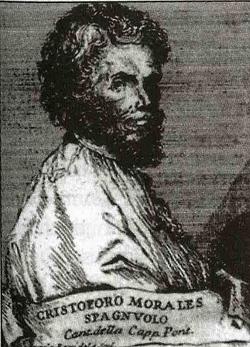
Cristobal de Morales (1500-1553); ESP

Loading, please wait...
Though his masses and motets brought him international fame, and Morales is today regarded as the most important Spanish ecclesiastical composer of the Renaissance, his career is well documented through his employment as a singer—including a decade in the papal choir—and maestro de capella of several prominent cathedrals. If there is hardly a single anecdote to lend personal color to a life spent in such exalted occupation, several things may be inferred. Foremost, there is pride in having been born in Seville, one of the great European cultural centers; pride in getting a thorough education (though there is no record of university study) for Morales claims to have mastered the Trivium and Quadrivium of the medieval curriculum; pride in his mastery of Classical—rather than ecclesiastical—Latin; and pride in his fluent technique—likely learned from Francisco de Peñalosa and Pedro de Escobar—which he turned to a contrapuntally elaborate, polyphonically rich, and suavely elevated utterance—anticipating (perhaps influencing) and rivaling that of Palestrina—in his 21 masses, more than 100 motets, and two sets of Magnificats. Clearly, Morales was omnicompetent and ambitious. He became maestro de capella at the Avila cathedral in 1526, moving on to Plasencia (at nearly double the salary) in 1528. Apparently, he was well regarded: in 1530 he was granted a month's leave to attend his sister's wedding and a substantial amount toward her dowry. Overstaying his visit, his salary was temporarily suspended and he resigned in December 1531. He next appears in the papal choir in Rome in September 1535, a post he held for the next decade, singing beside Arcadelt and Festa in the Sistine Chapel (whose frescos Michelangelo had completed in 1512) and before the crowned heads of Europe as part of the pope's retinue. His tenure was marked by increasing stints of illness. In 1544 two lavishly printed volumes of masses announced Morales' genius and his availability. Despite generous salary and vacations, he sought more remunerative employment, and when the pope conferred favors on less distinguished members of the choir, he resigned, leaving Rome in 1545 to return to Seville, where he taught Francisco Guerrero. In that year he became maestro of the primatical cathedral in Toledo, where he again fell ill, renouncing his post on August 9, 1547. He served as maestro to the Duke of Arcos at Marchena from 1548 to 1551. An unhappy term as maestro at Málaga Cathedral ended with Morales' death in the fall of 1553. © Adrian Corleonis, All Music Guide
Portions of Content Provided by All Music Guide.
© 2008 All Media Guide, LLC. All Music Guide is a registered trademark of All Media Guide, LLC.
AMG
Files of this type are not available at this time. Please select ALL from above.
  • Recordings:
  • Vocal Works
    • Masses
    • Motets
Files of this type are not available at this time. Please select ALL from above.
  • Free Play:
  • Vocal Works
    • Masses
    • Motets
Click on a category to view the list of works
 
The 0 or 1 suffix on the download button indicates the type of the MIDI file: Type 0 or Type 1. Some Disklavier, for example, can only play one or the other type. You should experiment first to see which type is compatible with your hardware.

Notation MusicianFor a great experience with MIDI files, we recommend the Notation Musician software - which shows you the score as you play the file! Click for a full description, or you can get a trial version, or you can buy the program now.

Notation ComposerIf you are more ambitious and wish to actually create or modify MIDI files, then you want to look at Notation Composer. Click for a full description, or you can get a trial version, or you can buy the program now.
© 1994-2012 Classical Archives LLC — The Ultimate Classical Music Destination ™