Composer (MIDI)
Carl Philipp Emanuel Bach (1714-1788); DEU
 Loading, please wait...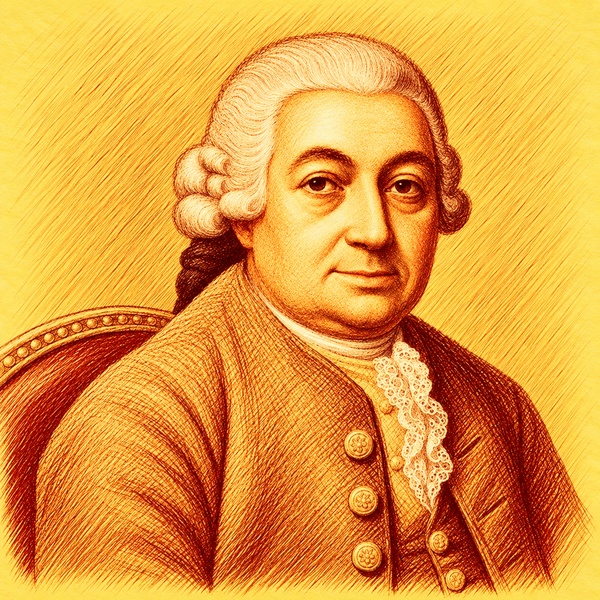
Carl Philipp Emanuel Bach (1714–1788), the second surviving son of Johann Sebastian Bach and Maria Barbara Bach, was one of the most influential composers of the generation between the Baroque and Classical eras. Born in Weimar and raised in a highly musical family, he studied law at the universities of Leipzig and Frankfurt an der Oder while developing into an accomplished keyboard player and composer. In 1740 he entered the service of Frederick the Great of Prussia as a court harpsichordist in Berlin and Potsdam, where he remained for nearly three decades. Although the conservative musical tastes of the Prussian court could be restrictive, Bach established a wide reputation through his compositions, performances, and writings. In 1768 he succeeded his godfather Georg Philipp Telemann as music director in Hamburg, taking responsibility for music at the city's principal churches and for numerous public performances. He remained in Hamburg until his death and was widely regarded by contemporaries as one of Europe's foremost musicians.
C. P. E. Bach's music stands at the center of the transition from Baroque complexity to the clarity and dramatic contrasts of the Classical style. He was a leading exponent of the empfindsamer Stil, or “sensitive style,” characterized by sudden changes of mood, unexpected harmonic turns, expressive pauses, and highly personal melodic writing. His extensive output includes keyboard sonatas, concertos, symphonies, chamber music, songs, and sacred vocal works. Among his important collections are the Prussian Sonatas, the Württemberg Sonatas, and the six collections published under the title Sonatas, Rondos and Fantasias for Connoisseurs and Amateurs. His orchestral writing reached particular intensity in the Hamburg Symphonies and the Four Orchestral Symphonies. Bach was also an important theorist and teacher: his Essay on the True Art of Playing Keyboard Instruments became one of the eighteenth century's most influential musical treatises. His expressive freedom and formal experimentation had a significant impact on Haydn, Mozart, Beethoven, and later generations of composers.

###
Bach, Carl Philipp Emanuel [Karl Philipp Emanuel Bach] (b Weimar, 1714; d Hamburg, 1788). Ger. composer. 5th child and 3rd son of J. S. Bach. Intended for legal career but turned to mus. while at Frankfurt Univ. In 1738 became cembalist in Berlin at court of Frederick the Great, holding this post until 1767, when he succeeded Telemann as dir. of church mus. at Hamburg. Applied unsuccessfully in 1750 to succeed his father at Leipzig. His achievement was to develop sonata-form and invest it with weight and imaginative quality, most evidently in his kbd. sonatas, of which there are over 200, but also in his sinfonias, concs. (over 50), vn. sonatas, and the masterly solo fl. sonata in A minor. Also comp. 22 Passions, Magnificat (1749), the oratorios Die Israeliten in der Wusten (1769) and Die Auferstehung und Himmelfahrt Jesu (1780), and many songs. Wrote celebrated treatise on klavier-playing.
Copyright © 1996 Oxford University Press - By permission of Oxford University Press
###
Read biography at allmusic.com.
|
|
Carl Philipp Emanuel Bach (1714–1788), the second surviving son of Johann Sebastian Bach and Maria Barbara Bach, was one of... More
|
 Files of this type are not available at this time. Please select ALL from above.
 Click on a category to view the list of works
-
Keyboard Works
16 midis
- Sonatas
8 midis
-
Other Keyboard Works
8 midis
- Sonatas
-
Orchestral Works
1 midi
-
Concertos for Wind Instruments
1 midi
-
Concertos for Wind Instruments
-
Chamber Works
2 midis
- Chamber Sonatas
1 midi
-
Other Chamber Works
1 midi
- Chamber Sonatas
-
Keyboard Works
16 midis
- Sonatas
8 midis
-
Other Keyboard Works
8 midis
- Sonatas
-
Orchestral Works
1 midi
-
Concertos for Wind Instruments
1 midi
-
Concertos for Wind Instruments
-
Chamber Works
2 midis
- Chamber Sonatas
1 midi
-
Other Chamber Works
1 midi
- Chamber Sonatas