Composer (MIDI)
Samuel Barber (1910-1981); USA
 Loading, please wait...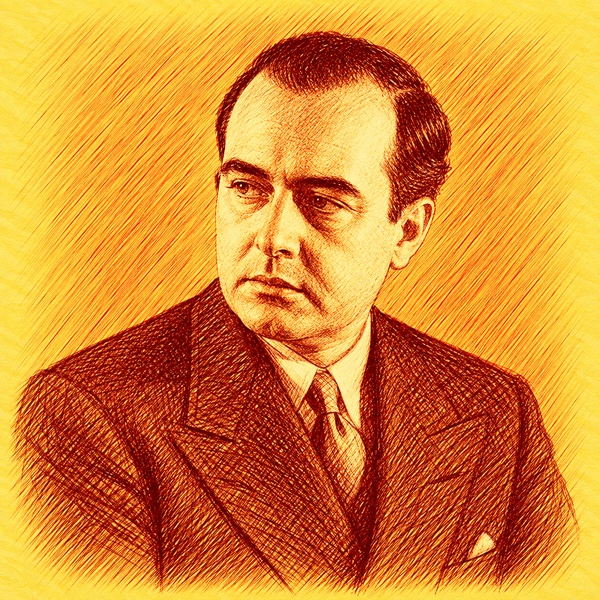
Samuel Barber (1910–1981) was an American composer whose lyrical, finely crafted music secured him a prominent place in twentieth-century American musical life. Born in West Chester, Pennsylvania, he showed exceptional musical ability from childhood and entered the Curtis Institute of Music in Philadelphia at fourteen, studying composition, piano, and voice. There he met the composer Gian Carlo Menotti, who became his lifelong companion and close artistic collaborator. Barber achieved international recognition while still a young man, winning major prizes and receiving performances by leading musicians and orchestras in the United States and Europe. Unlike many contemporaries who embraced increasingly experimental techniques, he retained a fundamentally tonal and expressive musical language, shaped by a deep knowledge of European tradition and by his own gift for vocal and instrumental lyricism. His career brought two Pulitzer Prizes and numerous commissions, although the hostile reception of his opera Antony and Cleopatra at the opening of the new Metropolitan Opera House in 1966 contributed to a difficult period in his later life.
Barber's music is distinguished by long melodic lines, rich harmony, structural clarity, and an emotional directness that could range from intimate reflection to dramatic intensity. His best-known composition, Adagio for Strings, originated as the slow movement of his String Quartet, Op. 11 and became one of the most widely recognized American concert works. His vocal writing was equally important, encompassing songs such as Knoxville: Summer of 1915, to a text by James Agee, and the song cycle Hermit Songs. Among his major orchestral and instrumental works are the Violin Concerto, Cello Concerto, Piano Concerto, and Symphony No. 1. His opera Vanessa won the Pulitzer Prize for Music in 1958, and the Piano Concerto earned him a second Pulitzer in 1963. Barber's ability to combine traditional forms with an unmistakably personal expressive voice has given his music an enduring place in the American repertory.

###
Barber, Samuel (b West Chester, Penn., 1910; d NY, 1981). Amer. composer. Played pf. at age 6 and composed when 7. At 14 entered Curtis Inst. as one of first charter students, studying comp. under Scalero 1925-34, pf. under Isabelle Vengerova 1926-31, and singing under Emilio de Gogorza 1926-30. In 1928 formed a lasting and fruitful friendship with Gian Carlo Menotti. From 1933 his comps. began to be played, notably his setting of Arnold's Dover Beach, in which he sang the bar. part, and his Vc. Sonata, in which he played the pf. In 1935 won a Pulitzer scholarship and in 1936 the Amer. Academy's Prix de Rome. His first sym. was given its f.p. in Rome that year, cond. Molinari. Toscanini cond. f.ps. of his Adagio for Strings (orig. the slow movement of his str. qt.) and the first Essay for Orchestra in 1938 and in subsequent years f.ps. of his works were given in NY, Boston, and Philadelphia under Walter, Koussevitzsky, Leinsdorf, Mitropoulos, Ormandy, and Mehta. His 4-act opera Vanessa, to lib. by Menotti, was perf. at the NY Met in 1958 and another opera Antony and Cleopatra, to lib. by Zeffirelli, was commissioned for the opening of the new Metropolitan in the Lincoln Center, NY, in Sept. 1966.
Barber's mus. is in the European traditional line rather than specifically ‘American’. Conservative in idiom, it is melodic, elegant, and brilliant. His lyricism is best heard in Vanessa and in Knoxville: Summer of 1915, for sop. and orch., and his romanticism in Dover Beach, the Vc. Sonata, and the Sym. No.1. His Pf. Sonata, first played by Horowitz, is a bravura work. The operas met with a poor initial response which is in process of being reversed, and the concs. and songs are highly effective. Prin. works:
OPERAS: Vanessa, Op.32 (1957, rev. 1964); A Hand of Bridge, Op.35 (1959); Antony and Cleopatra, Op.40 (1966, rev. 1974).
BALLETS: Medea, Op.23 (1946, rev. as Cave of the Heart, 1947); Souvenirs, Op.28 (1952).
ORCH.: sym. No.1, Op.9 (1936), No.2, Op.19 (1944); Overture to School for Scandal, Op.5 (1931); Music for a Scene from Shelley, Op.7 (1933); Essay No.1, Op.12 (1937), No.2, Op.17 (1942), No.3, Op.47 (1978); Adagio for Strings, Op.11 (1938) (orch. from str. qt. Op.11); Mutations from Bach, brass, timp. (1967); Fadograph of a Yestern Scene, Op.44 (1971).
CONCERTOS: vn., Op.14 (1939); vc., Op.22 (1945); pf., Op.38 (1962); Capricorn Concerto, Op.21 (for chamber orch.) (1944); Canzonetta, ob., str., Op.48 (1977-8).
VOCAL AND CHORAL: Dover Beach, Op.3 (bar. or cont. with str. qt. or str. orch.) (1931); A Stopwatch and an Ordnance Map, Op.15, male vv., timp. (1939); Knoxville: Summer of 1915, Op.24, sop., orch. (1947, arr. for sop. and chamber orch. 1950); Prayers of Kierkegaard, Op.30, sop., orch. (1954); Andromache's Farewell, Op.39, sop., orch. (1962); Agnus Dei (1967, choral vers. of Adagio for Strings).
CHAMBER MUSIC: Serenade, Op.1, str. qt. (1928, arr. for str. orch. 1944); vc. sonata, Op.6 (1932); str. qt., Op.11 (1936); Excursions, Op.20, pf. (1942-4); pf. sonata, Op.26 (1949); Souvenirs, Op.28, pf., 4 hands (1951, arr. for pf. solo, for 2 pfs. and for orch., 1952); Summer Music, Op.31 (woodwind quintet) (1955); Canzone (Elegy), Op.38a, fl. or vn., pf. (1958).
He also comp. many songs, incl. 10 Hermit Songs, Op.29 to Irish texts (1952-3).
Copyright © 1996 Oxford University Press - By permission of Oxford University Press
###
Read biography at allmusic.com.
|
|
Samuel Barber (1910–1981) was an American composer whose lyrical, finely crafted music secured him a prominent place in twentieth-century American... More
|
 Files of this type are not available at this time. Please select ALL from above.
-
Keyboard Works
1 midi
- Piano Sonata in Eb-, Op.26
1 midi
- Piano Sonata in Eb-, Op.26
-
Keyboard Works
1 midi
- Piano Sonata in Eb-, Op.26
1 midi
- Piano Sonata in Eb-, Op.26