Composer (MIDI)
(Louis) Hector Berlioz (1803-1869); FRA
 Loading, please wait...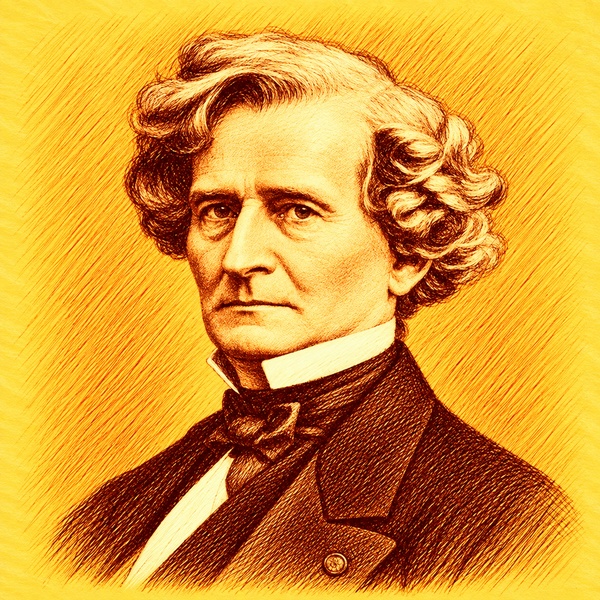
Hector Berlioz (1803–1869) was a French composer, conductor, and writer whose originality made him one of the defining figures of musical Romanticism. Born at La Côte-Saint-André in southeastern France, he was sent to Paris to study medicine but abandoned it for music, entering the Paris Conservatoire and studying composition with Jean-François Le Sueur. In 1830 he won the Prix de Rome after several attempts, the same year in which his fascination with the Irish actress Harriet Smithson inspired his most famous early work. Berlioz and Smithson married in 1833, though the marriage later deteriorated. Often struggling for recognition in France, Berlioz supported himself partly through brilliant and sometimes caustic music criticism while building an international reputation as a conductor. Extensive tours through Germany, Russia, Britain, and elsewhere brought him greater acclaim abroad than he frequently enjoyed in Paris, and his writings, including his influential treatise on orchestration and his Memoirs, established him as one of the most perceptive musical authors of his century.
Berlioz radically expanded the expressive and dramatic possibilities of the orchestra, using unprecedented combinations of instruments, spatial effects, and large forces while retaining an intensely personal melodic language. His Symphonie fantastique transformed the symphony into an autobiographical drama unified by the recurring idée fixe, while Harold in Italy combined symphonic form with a prominent solo viola. The monumental Requiem and Te Deum exploit immense vocal and orchestral resources, whereas the dramatic symphony Roméo et Juliette reveals his lifelong engagement with Shakespeare. His theatrical works include Benvenuto Cellini, Béatrice et Bénédict, and the epic Les Troyens, based on Virgil’s Aeneid. The song cycle Les Nuits d'été shows a more intimate side of his art. Berlioz’s innovations in orchestration, program music, and large-scale dramatic form profoundly influenced later composers including Liszt, Wagner, Mahler, Richard Strauss, and the Russian school.

###
Berlioz, (Louis) Hector (b La Côte-St André, Grenoble, 1803; d Paris, 1869). Fr. composer, cond., and critic. His life, especially as related by himself in his marvellous Memoirs, reads like a novel. Son of a provincial doctor, he showed early liking for mus., learning the fl. and flageolet, and later the guitar, but never the pf. Intended for a medical career, in 1821 went to Paris medical sch. In 1822 applied for mus. lessons and began to compose an opera. In 1823 he became a private pupil of Le Sueur and in 1824 comp. his Messe solennelle. This was perf. in Paris 1825 and 1827. Berlioz said he destroyed the score, but in fact he gave it to his friend Antoine Bessems in 1835 and this was found in Antwerp in 1991 by Frans Moors, an organist, and received its f. modern. ps. 1993 in Paris, Bremen, and London, all cond. John Eliot Gardiner.
In 1826 entered Paris Cons. to study with Reicha and Le Sueur, 1826-8. In 1827 saw Kemble's co. in Hamlet at the Odéon and was stricken ‘like a thunderbolt’ with a passion both for Shakespeare and for the Irish actress who played Ophelia, Harriet Smithson. In the first 5 months of 1830, comp. the Symphonie fantastique, subtitled ‘Episodes in the life of an artist’ and dealing autobiographically with his passion for Miss Smithson. It was perf. on 5 Dec. In Dec. 1832 at last met Miss Smithson and married her 10 months later. Over the next decade some of his greatest works were comp., incl. Harold in Italy, the Symphonie funèbre et triomphale, the dramatic sym. Roméo et Juliette, the Grand’ Messe des morts (Requiem), and the opera Benvenuto Cellini. Though some of these works were commissions (and Paganini gave him 20,000 francs for Harold in Italy, although he never played the va. solo), Berlioz supplemented his income by writing mus. criticism, a chore he detested but accomplished brilliantly. In 1841 his marriage broke up and he formed a liaison with the singer Marie Recio. They toured Ger. in 1843, and in the ensuing years he travelled frequently, visiting Russia and also paying 4 visits to London. Dramatic cantata La Damnation de Faust was a failure in Paris, 1846, and Te Deum, comp. 1849-50, was not perf. until 1855. From 1856 to 1858 engaged on enormous opera Les Troyens, for which he wrote the lib., basing it on Virgil's Aeneid. This work, Berlioz's masterpiece, was on too large a scale and efforts to have it staged at the Opéra failed. Eventually, having divided it into 2 parts, La Prise de Troie and Les Troyens à Carthage, he saw the 2nd part prod. at the Théâtre-Lyrique, Paris, in Nov. 1863. It was withdrawn after 22 perfs., a failure which broke Berlioz's spirit. In 1860-2 completed his last work, the comic opera Béatrice et Bénédict, based on Shakespeare. For nearly 100 years after his death, Berlioz's true qualities were obscured by his image as the ‘Romantic artist’ par excellence. His extravagances in his scores, no longer very remarkable but ahead of their time, diverted critical attention, even among his admirers, from the classical purity of his melody and the Beethovenian grandeur of his command of dramatic contrasts. Today, the opera Les Troyens, the Grand’ Messe des morts and the Nuits d'été (forerunner of Mahler's song-cycles with orch.) are recognized for their poetry and originality. Prin. comps.:
STAGE: Les Francs Juges, Op.3 (1826, rev. 1829, 1833); Benvenuto Cellini, Op.23 (1834-7); Les Troyens (1856-8); Béatrice et Bénédict (1860-2); Lélio (monodrama, 1831).
ORCH.: ovs.: Waverley, Op.1 bis (1827-8); Les Francs Juges, Op.3 (1826); Le Roi Lear, Op.4 (1831); Le Corsaire, Op.21 (1831); Rob Roy (1832); Le Carnaval romain, Op.9 (1844); Harold en Italie, va., orch., Op.16 (1834); Symphonie fantastique, Op.14 (1830); Révérie et caprice, vn., orch., Op.8 (1839); Symphonie funèbre et triomphale (ch. ad lib.), Op.15 (1840).
VOICES & ORCH.: Messe solennelle (1824); Grand’ Messe des morts (Requiem), Op.5 (1837); La Mort de Cléopâtre (1829); Roméo et Juliette, dramatic sym., Op.17 (1838-9); La Damnation de Faust, Op.24 (1828-46); L'Enfance du Christ, oratorio, Op.25 (1850-4); Te Deum, Op.22 (1849-50); Les Nuits d'été (with pf. or orch.), Op.7 (1840-1, pf.; 1843-56, orch.).
Copyright © 1996 Oxford University Press - By permission of Oxford University Press
###
Read biography at allmusic.com.
|
|
Hector Berlioz (1803–1869) was a French composer, conductor, and writer whose originality made him one of the defining figures of... More
|
 Files of this type are not available at this time. Please select ALL from above.
 Click on a category to view the list of works
-
Stage Works
2 midis
-
Orchestral Works
24 midis
- Symphonies
20 midis
-
Other Orchestral Works
4 midis
- Symphonies
-
Vocal Works
4 midis
-
Choral Works
4 midis
-
Choral Works
-
Stage Works
2 midis
-
Orchestral Works
24 midis
- Symphonies
20 midis
-
Other Orchestral Works
4 midis
- Symphonies
-
Vocal Works
4 midis
-
Choral Works
4 midis
-
Choral Works