Composer (MIDI)
Alexander Borodin (1833-1887); RUS
 Loading, please wait...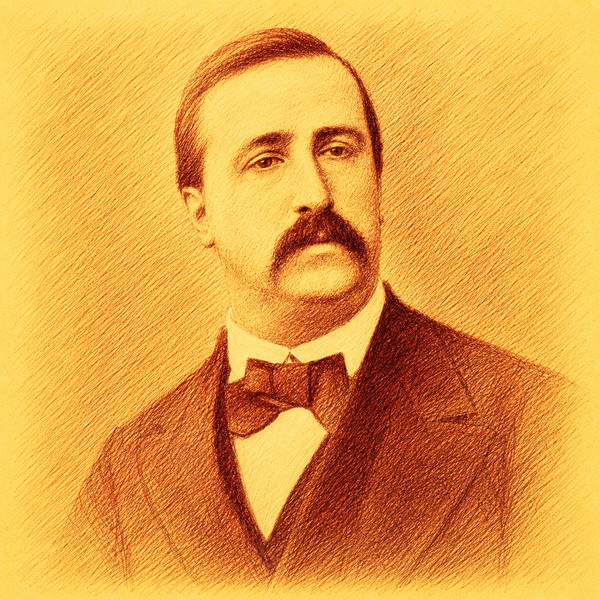
Alexander Borodin (1833–1887) was a Russian composer and distinguished chemist who pursued music alongside a major scientific career. Born in St. Petersburg, the illegitimate son of a Georgian prince, he received a broad private education and showed early talent in both music and science. He trained as a physician at the Medical-Surgical Academy and later became a professor of chemistry there, conducting important research and helping promote medical education for women. Music remained an intense but essentially secondary occupation, composed largely during holidays or periods of illness. In the 1860s Borodin became associated with Mily Balakirev and the circle later known as “The Five,” whose members sought to develop a distinctly Russian school of composition independent of Western European academic models. His demanding scientific and administrative responsibilities, together with his painstaking compositional habits, left a relatively small body of music, and several major works remained unfinished at his sudden death in 1887.
Borodin’s music combines Russian melodic character with rich lyricism, vivid orchestral color, and a strong command of large-scale form. His two completed symphonies, particularly the powerful Symphony No. 2 in B minor, helped establish a Russian symphonic tradition, while the tone poem In the Steppes of Central Asia remains a masterly example of musical atmosphere and orchestral economy. His chamber music includes the lyrical String Quartet No. 2, whose celebrated Nocturne displays his gift for expansive melody. Borodin devoted many years to his opera Prince Igor, left incomplete at his death and subsequently prepared for performance by Rimsky-Korsakov and Glazunov; its Polovtsian Dances became internationally famous. Despite composing only intermittently, Borodin created music of remarkable individuality, balancing nationalist color with structural discipline and a melodic generosity that secured his place among the most enduring Russian composers of the nineteenth century.

###
Borodin, Alexander (Porfiryevich) (b St Petersburg, 1833; d St Petersburg, 1887). Russ. composer, one of the group known as ‘The Five’. Illegitimate son of Russ. prince. Showed childhood talent for mus. and science, composing pf. pieces and fl. conc. Entered medical profession, graduating in 1855, Acad. of Medicine and Surgery, St Petersburg. Studied science in Heidelberg and elsewhere 1859-62. Appointed ass. prof. of chemistry, Acad. of Medicine 1862, prof. from 1864. Meeting with Balakirev 1862 persuaded him to devote leisure to serious study of mus. while continuing his scientific work, which incl. foundation of School of Medicine for Women, where he lectured from 1872 to his death. His first sym. was prod. 1869, but he had already tasted failure with comic opera The Bogatyrs in 1867. His Sym. No.2 in B minor was also a failure at f.p. 1877, the year in which he visited Liszt at Weimar. Liszt in 1880 ensured a perf. of the First Sym. at Baden-Baden which initiated Borodin's popularity outside Russia. In 1869 his friend Stasov suggested an opera on the subject of Prince Igor. This appealed to Borodin's nationalism, but difficulties with the lib., plus the interruptions from his scientific career, made comp. slow and the work, Borodin's masterpiece, was never finished, but was completed by Rimsky-Korsakov and Glazunov. Melodic and harmonic originality of Borodin's style are best heard in Prince Igor, but the second sym., the 2 str. qts., and the tone-poem In the Steppes of Central Asia (1880) ensure his survival. Prin. works:
OPERA: Prince Igor (unfinished, completed and partly orch. by Rimsky-Korsakov and Glazunov) (1869-70, 1874-87).
ORCH.: syms.: No.1 in Eb (1862-7), No.2 in B minor (1869-76), No.3 in A minor (1885-6, unfinished, completed and orch. by Glazunov); tone-picture In the Steppes of Central Asia (V sredney Azii) (1880); Nocturne from 2nd str. qt., orch. Sargent.
CHAMBER MUSIC: str. qts.: No.1 in A major (1877-9), No.2 in D (1881-7); pf. quintet in C minor (1862).
PIANO: Petite Suite (1885), orch. Glazunov; Scherzo in Ab Polka, Requiem, Dead March, and Mazurka in coll. Paraphrases on theme of Chopsticks (1880).
Copyright © 1996 Oxford University Press - By permission of Oxford University Press
###
Read biography at allmusic.com.
|
|
Alexander Borodin (1833–1887) was a Russian composer and distinguished chemist who pursued music alongside a major scientific career. Born in... More
|
 Files of this type are not available at this time. Please select ALL from above.
 Click on a category to view the list of works
-
Stage Works
2 midis
-
Orchestral Works
2 midis
-
Other Orchestral Works
2 midis
- In the Steppes of Central Asia
2 midis
- In the Steppes of Central Asia
-
Other Orchestral Works
-
Chamber Works
5 midis
- String Quartet No.1 in A
4 midis
- String Quartet No.2 in D
1 midi
- String Quartet No.1 in A
-
Vocal Works
1 midi
-
Stage Works
2 midis
-
Orchestral Works
2 midis
-
Other Orchestral Works
2 midis
- In the Steppes of Central Asia
2 midis
- In the Steppes of Central Asia
-
Other Orchestral Works
-
Chamber Works
5 midis
- String Quartet No.1 in A
4 midis
- String Quartet No.2 in D
1 midi
- String Quartet No.1 in A
-
Vocal Works
1 midi