Composer (MIDI)
Emmanuel Chabrier (1841-1894); FRA
 Loading, please wait...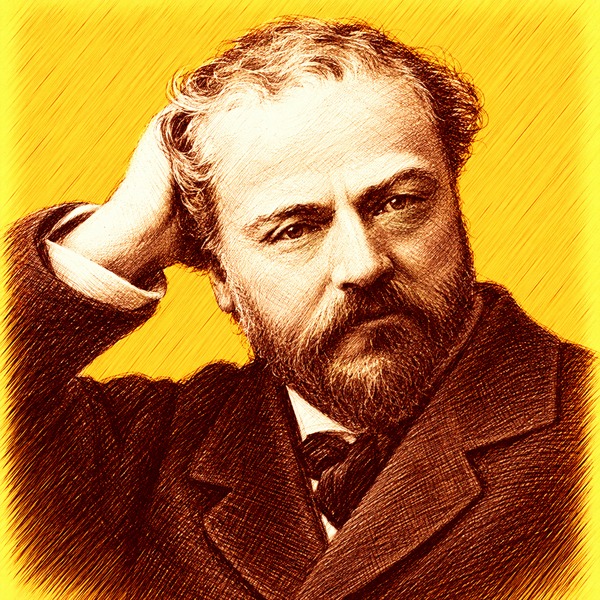
Emmanuel Chabrier (1841–1894) was a French composer whose colorful, harmonically adventurous music exerted an influence disproportionate to the relatively small size of his output. Born in Ambert in central France, he studied piano from childhood but followed his family’s wishes by pursuing law and entering government service in Paris. Music nevertheless remained central to his life, and he became closely connected with leading artists, writers, and musicians. In 1880, after hearing Wagner’s Tristan und Isolde in Munich, Chabrier resigned from the Ministry of the Interior to devote himself fully to composition. His friendships with painters including Édouard Manet and his enthusiasm for contemporary art paralleled his own independent musical sensibility. Although illness curtailed his final years, Chabrier earned the admiration of younger French composers, including Debussy, Ravel, and Poulenc.
Chabrier’s music combines rhythmic exuberance, brilliant orchestral color, melodic wit, and an unusually fresh harmonic language. His best-known work, the orchestral rhapsody España, was inspired by a journey through Spain and became an immediate success through its dazzling rhythms and instrumentation. The piano pieces Dix pièces pittoresques reveal harmonic and textural innovations that anticipated important aspects of later French music; Ravel particularly admired them. Chabrier also wrote operas and operettas, including L'étoile, a sparkling comic work, and the more ambitious Gwendoline. The orchestral Joyeuse marche captures his characteristic vitality and humor. Although he admired Wagner, Chabrier’s own music remained distinctly French in clarity, brevity, and wit. His bold harmonies and vivid instrumental imagination helped loosen French music from academic convention and contributed significantly to the emergence of the modern French school.

###
Chabrier, (Alexis) Emmanuel (b Ambert, Puy-de-Dôme, 1841; d Paris, 1894). Fr. composer, pianist, and conductor. Studied pf., vn., and comp. in boyhood, but had general education, entered law school, and worked as civil servant in Ministry of the Interior 1861-80, during which time he became friend of Manet, who painted him twice, and Fauré, Duparc, and Chausson. Hearing Wagner's Tristan und Isolde in Munich determined him to resign his govt. post and concentrate wholly on mus. After visiting Sp. wrote orch. rhapsody España, 1883. Became ass. ch.-master to Lamoureux in Paris in 1881. Became fervent admirer of and propagandist for Wagner. Works incl. operas L'étoile (1877), Une Education manquée (1879), Gwendoline (1885), Le Roi malgré lui (1887) and Briséis (1888-91, unfinished); Suite pastorale, orch. (1881); Joyeuse Marche, orch. (1888); pf. pieces and songs (incl. Ballade des gros dindons, 1889).
Copyright © 1996 Oxford University Press - By permission of Oxford University Press
###
Read biography at allmusic.com.
|
|
Emmanuel Chabrier (1841–1894) was a French composer whose colorful, harmonically adventurous music exerted an influence disproportionate to the relatively small... More
|
 Files of this type are not available at this time. Please select ALL from above.
 Click on a category to view the list of works
-
Piano Works
13 midis
- Bourrée fantasque
1 midi
- Feuillet d'album
1 midi
- 10 Pièces pittoresques
11 midis
- Bourrée fantasque
-
Orchestral Works
2 midis
-
Other Orchestral Works
2 midis
-
Other Orchestral Works
-
Piano Works
13 midis
- Bourrée fantasque
1 midi
- Feuillet d'album
1 midi
- 10 Pièces pittoresques
11 midis
- Bourrée fantasque
-
Orchestral Works
2 midis
-
Other Orchestral Works
2 midis
-
Other Orchestral Works