Composer (MIDI)
Antonín (Leopold) Dvořák (1841-1904); CZE
 Loading, please wait...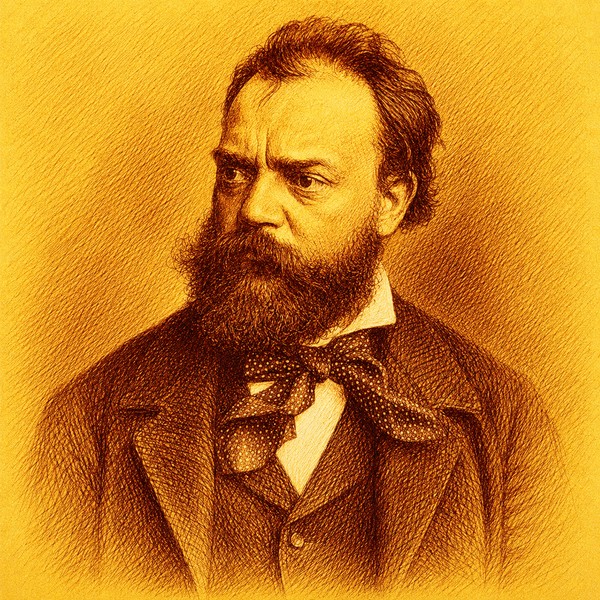
Antonín Dvořák (1841–1904) was a Czech composer whose music brought the traditions and character of Bohemia into the international concert repertory. Born in Nelahozeves, north of Prague, he trained as an organist and initially earned his living as a violist in Prague orchestras while composing in relative obscurity. Recognition came gradually, aided decisively by Johannes Brahms, who recommended Dvořák to the publisher Fritz Simrock after serving on a committee that awarded him an Austrian state stipend. The resulting publication of the Slavonic Dances brought widespread success. Dvořák subsequently conducted and traveled extensively in Europe and, from 1892 to 1895, served as director of the National Conservatory of Music in New York. He returned to Prague, where he later became director of the Prague Conservatory and remained a revered figure until his death.
Dvořák combined Classical formal discipline with Romantic lyricism and rhythmic and melodic elements inspired by Czech and other Slavic traditions. His nine symphonies culminate in the Symphony No. 9 “From the New World”, composed in the United States and shaped by his interest in African American and Native American musical traditions without directly quoting their melodies. The Cello Concerto in B minor is one of the central works of the instrument’s repertory, while chamber masterpieces include the String Quartet No. 12 “American” and the Piano Quintet No. 2. The Slavonic Dances transformed folk-dance rhythms into sophisticated concert music, and the opera Rusalka contains some of his most lyrical writing. Dvořák’s ability to unite national character with universal musical forms made him one of the most widely admired composers of the late nineteenth century.

###
Dvořák, Antonín (Leopold) (b Nelahozeves, Bohemia, 1841; d Prague, 1904). Cz. (Bohem.) composer. Son of a village butcher, Dvořák as a child helped in the shop and also showed talent as a violinist. At 14 he was sent to relatives in Zlonice to learn Ger.; while there he was taught va., org., pf., and counterpoint by A. Liehmann. From 1857 to 1859 he attended the Org. Sch., Prague, leaving to become va. player in a band and later in the orch. of Prague Nat. Th., 1866-73, playing under Smetana. At this time he comp. several works which he later destroyed or withdrew, the most significant being a song-cycle Cypress Trees from which he drew themes in later years (for the Vc. Conc., for example). The cycle was a tale of disappointed love, the result of Dvořák's disappointment that a girl he adored married someone else. (He later married her sister.) Like most young composers of the time, his natural tendencies were complicated by the inescapable influence of Wagner. His first opera, Alfred (1870) was Wagnerian in tone. Three years later he had his first major success with a cantata, Hymnus (The Heirs of the White Mountain), which enabled him to give up his orch. playing. In 1874 his sym. in Eb won him an Austrian nat. prize, Brahms being on the jury. Two years later the Moravian duets won him the same prize, and Brahms recommended them to the publisher Simrock. The nationalist element in such works as the Slavonic Rhapsodies—the results of Smetana's beneficial influence—earned Dvořák increasing recognition and requests for new works e.g. from Joachim for a vn. conc. and from Hans Richter for a sym. Both Richter and Bülow championed his mus. in their concerts. In 1884 he paid the first of 9 visits to England and cond. his Stabat Mater which had scored a tremendous success the previous year under Barnby. His popularity in Britain was immediate and sustained both as comp. and cond., and he was financially successful enough to be able to buy an estate in S. Bohemia. Several of his works were written for or first perf. in Eng., e.g. the sym. in D minor (No.7), comp. for the Phil. Soc. (1885), the cantata The Spectre's Bride (Birmingham, 1885), the oratorio St Ludmila (Leeds, 1886), the sym. in G major (No.8) (Phil. Soc. 1888), and the Requiem (Birmingham, 1891). Cambridge made him Hon. D.Mus. in 1891 and in the same year he was appointed prof. of comp. at Prague Cons. The Cons. granted him leave to accept the invitation of Mrs Jeanette Thurber, founder in 1885 of the Nat. Cons. of Mus., NY, to become dir. of the cons. He remained in Amer. for 3 years, a fruitful period in which he wrote some of his finest works, incl. the ‘New World’ Sym., the vc. conc., the Biblical Songs, the str. qt. Op.96, and the str. quintet Op.97. His art seems to have been intensified by a combination of the influence of Negro melodies and of a deep homesickness. He returned to his teaching post in Prague in 1895, becoming dir. of Prague Cons. in 1901. His pupils incl. his son-in-law Suk, and Novák. In his last years he devoted his creative energies to symphonic poems and to operas.
Dvořák's mus. is a particularly happy result of the major influences on his art: Wagner, Brahms, and folk mus. His innate gift for melody was Schubertian and his felicitous orchestration, often reflecting natural and pastoral elements, is of an art that conceals art. But a tendency to regard him as blithely naïve would be both unjust and misleading, for his mastery of form and his contrapuntal and harmonic skill are the manifestations of a powerful mus. intellect. The nationalist feeling in his mus. is beautifully integrated into classical structures and his use of Cz. dances and songs, such as the furiant, polka, skočná (reel), dumka, and sousedská (slow waltz), is in no way bizarre. His syms., the vc. conc., and perhaps above all his chamber mus. show the best side of his work; the operas, apart from Rusalka, are only just beginning to travel outside Czechoslovakia; and the choral works which won him such a following in late Victorian Eng. are due for rehabilitation. For many years it was customary to credit him only with the 5 syms. pubd. in his lifetime, but the 4 early examples have now been accepted into the canon and the whole series is numbered chronologically. Prin. works:
OPERAS: Alfred (unpubd.) (1870); King and Charcoal Burner (Král a uhliř) (1871, totally re-composed 1874, rev. 1887), Op.14; The Stubborn Lovers (Tvrdé palice) (1874), Op.17; Vanda (1875, rev. 1879, 1883) Op.25; The Peasant a Rogue (Šelma sedlák) (1877), Op.35; Dimitrij (1881-2, revs. 1883, 1885, 1894-5), Op.64; The Jacobin (1887-8, rev. 1897), Op.84; Kate and the Devil (Čert a Káča) (1898-9), Op.112; Rusalka (1900), Op.114; Armida (1902-3), Op.115.
SYMPHONIES: No.1 in C minor (The Bells of Zlonice) (1865) (no Op. no., recovered 1923, pubd. 1961); No.2 in Bb (1865) (no Op. no.); No.3 in Eb (1873), (no Op. no. but orig. Op.10); No.4 in D minor (1874) (no Op. no. but orig. Op.13, pubd. 1912); No.5 in F major (1875, rev. 1887), Op.76 (orig. Op.24 and formerly No.3); No.6 in D major (1880), Op.60 (formerly No.1); No.7 in D minor (1884-5), Op.70 (formerly No.2); No.8 in G major (1889), Op.88 (formerly No.4); No.9 in E minor (From the New World) (1893), Op.95 (formerly No.5).
ORCH.: sym.-poems: The Water sprite (Vodník), Op.107 (1896); The Noonday Witch (Polednice), Op.108 (1896); The Golden Spinning Wheel (Zlatý Kolovrat), Op.109 (1896); The Wood Dove (Holoubek), Op.110 (1896); Heroic Song, Op.111 (1897); Ovs.: My Home, Op.62a (1882); Hussite (Husitská), Op.67 (1883); Cycle, Nature, Life and Love comprising Amid Nature, Op.91, Carneval, Op.92, and Othello, Op.93 (1891-2); Serenade in E major, str., Op.22 (1875); Suite in D (Czech), Op.39 (1879); Serenade in D minor, wind, vc., bass, Op.44 (1878); 3 Slavonic Rhapsodies in D, G minor, and Ab, Op.45 (1878); 8 Slavonic Dances, 1st series, Op.46 (1878), 8 (2nd series) Op.72 (1886); Legends, Op.59 (1881); Scherzo capriccioso, Op.66 (1883); Symphonic variations, Op.78 (1877, orig. Op.40).
SOLOIST & ORCH.: vc. conc. in A major (1865, with pf. acc. only. Orch. Raphael 1928, Burghauser 1975, vc. part ed. Sádló); Romance for vn., Op.11 (1873-7, arr. of andante con moto of str. qt. in F minor, Op.9, of 1873); pf. conc. in G minor, Op.33 (1876); Mazurka for vn., Op.49 (1879); vn. conc. in A minor, Op.53 (1879-80); Rondo for vc., Op.94 (1893); Forest Calm, for vc. (1891); vc. conc. in B minor, Op.104 (1894-5).
CHAMBER MUSIC: string quartets: F minor, Op.9 (1873), A minor, Op.12 (1873), A minor, Op.16 (1874), D minor, Op.34 (1877), Eb, Op.51 (1878-79), C major, Op.61 (1881), E major, Op.80 (1876, orig. Op.27), F major (the ‘American’), Op.96 (1893), Ab, Op.105 (1895), G major, Op.106 (1895). Also several without Opus no. incl. Cypresses (Cypřiše) (1887); string quintets: G major, Op.77, with db. (1875, orig. Op.18), Eb, Op.97 (1893); string sextet: A major, Op.48 (1878); pf. trios: Bb, Op.21 (1875), G minor, Op.26 (1876), F minor, Op.65 (1883), E minor (Dumka) Op.90 (1890-1); pf. qts.: D major, Op.23 (1875), Eb, Op.87 (1889); pf. quintet: A major, Op.81 (1887); Bagatelles (Maličkosti), 2 vn., vc., harmonium (or pf.), Op.47 (1878); Terzetto, 2 vn., va., Op.74 (1887); vn. sonata: F major, Op.57 (1880); vn. sonatina in G, Op.100 (1893).
CHORAL: Stabat Mater, Op.58 (1876-7, orig. Op.28); The Spectre's Bride, Op.69 (1884); St Ludmila, Op.71 (1885-6); Mass in D, Op.86 (1887, rev. 1892); Requiem, Op.89 (1890); The American Flag, Op.102 (1892); Te Deum, Op.103 (1892); Hymn of the Czech Peasants (Hymna ceského rolnictva), Op.28 (1885); with 4-hand acc., Hymnus, Op.30 (1872, orig. Op.4); Amid Nature (Vpřírodě), 5 ch., Op.63 (1882).
SONGS: cycle, Cypress Trees, 18 songs to words by Pflager (1865), unpubd. in orig. form but pubd. as 4 Songs, Op.2, 8 Love Songs, Op.83 (1888) and Cypress Trees for str. qt; 5 Evening Songs, Op.31 (1876); 3 Modern Greek Songs, Op.50 (1878); 7 Gipsy Songs, Op.55 (1880; No.4 is Songs my Mother taught me); 4 Songs, Op.82 (1887-8); 10 Biblical Songs, Op.99 (1894, Nos. 1 and 5 are orch.).
PIANO: Silhouettes, Op.8 (1879); Dumka and Furiant, Op.12 (1884); Dumka, Op.35 (1876); Theme and Variations, Op.36 (1876); Scottish Dances, Op.41 (1877); 4 Pieces, Op.52 (1880); 8 Waltzes, Op.54 (1879-80; Nos. 1 and 4 arr. for str. qt.); 6 Mazurkas, Op.56 (1880); Poetic Tone Pictures (Poetické nálady), Op.85 (1889); Suite in A, Op.98 (1894, arr. for orch.); 8 Humoresques, Op.101 (1894; No.7 is the famous one); Éclogues (1880); Album Leaves (1881).
PIANO DUETS: 16 Slavonic Dances, Opp. 46 and 72 (2 sets of 8; also for orch.); Legends, Op.59 (1881, also for orch.); From the Bohemian Forest (Ze Šumavy), Op.68 (1884).
Copyright © 1996 Oxford University Press - By permission of Oxford University Press
###
Read biography at allmusic.com.
|
|
Antonín Dvořák (1841–1904) was a Czech composer whose music brought the traditions and character of Bohemia into the international concert... More
|
 Files of this type are not available at this time. Please select ALL from above.
 Click on a category to view the list of works
-
Stage Works
2 midis
-
Keyboard Works
95 midis
- 2 Furiants, B.85, Op.42
1 midi
- 8 Humoresques, Op.101
11 midis
- 10 Legends, Op.59, B.117
7 midis
- 13 Poetic Tone Pictures, Op.85
5 midis
- 12 Silhouettes, Op.8
12 midis
- Slavonic Dances, B.145, Op.72
18 midis
- 8 Slavonic Dances, B.78, Op.46
38 midis
- Suite in A, Op.98
1 midi
- Theme and Variations, Op.36
1 midi
- 8 Waltzes, B.101, Op.54
1 midi
- 2 Furiants, B.85, Op.42
-
Orchestral Works
53 midis
- Symphonies
32 midis
-
Concertos
7 midis
-
Other Orchestral Works
14 midis
- Carnival, Op.92
1 midi
- Czech Suite, Op.39
5 midis
- Othello, B.174, Op.93
1 midi
- Serenade for Strings in E, Op.22
5 midis
- Serenade in D- for Winds, Cello, and Contrabass, B.77, Op.44
1 midi
- 3 Slavonic Rhapsodies, Op.45
1 midi
- Carnival, Op.92
- Symphonies
-
Chamber Works
29 midis
- String Quartets
17 midis
-
Other Chamber Works
12 midis
- String Quartets
-
Vocal Works
13 midis
- Songs
13 midis
- Songs
-
Stage Works
2 midis
-
Keyboard Works
95 midis
- 2 Furiants, B.85, Op.42
1 midi
- 8 Humoresques, Op.101
11 midis
- 10 Legends, Op.59, B.117
7 midis
- 13 Poetic Tone Pictures, Op.85
5 midis
- 12 Silhouettes, Op.8
12 midis
- Slavonic Dances, B.145, Op.72
18 midis
- 8 Slavonic Dances, B.78, Op.46
38 midis
- Suite in A, Op.98
1 midi
- Theme and Variations, Op.36
1 midi
- 8 Waltzes, B.101, Op.54
1 midi
- 2 Furiants, B.85, Op.42
-
Orchestral Works
53 midis
- Symphonies
32 midis
-
Concertos
7 midis
-
Other Orchestral Works
14 midis
- Carnival, Op.92
1 midi
- Czech Suite, Op.39
5 midis
- Othello, B.174, Op.93
1 midi
- Serenade for Strings in E, Op.22
5 midis
- Serenade in D- for Winds, Cello, and Contrabass, B.77, Op.44
1 midi
- 3 Slavonic Rhapsodies, Op.45
1 midi
- Carnival, Op.92
- Symphonies
-
Chamber Works
29 midis
- String Quartets
17 midis
-
Other Chamber Works
12 midis
- String Quartets
-
Vocal Works
13 midis
- Songs
13 midis
- Songs