Composer (MIDI)
George Gershwin (1898-1937); USA
 Loading, please wait...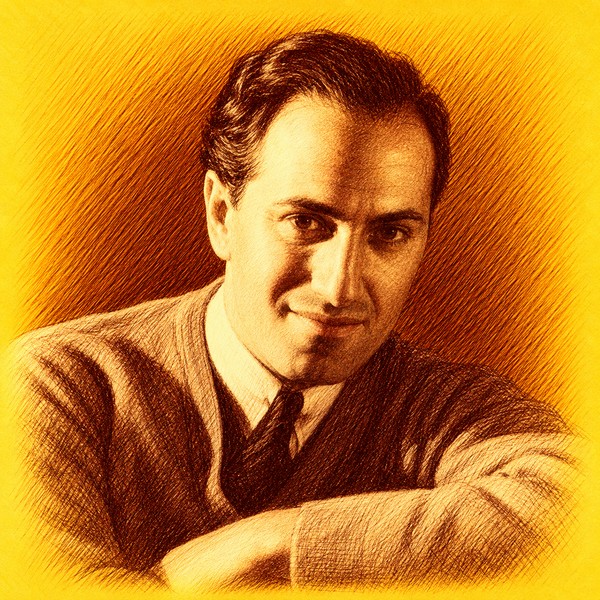
George Gershwin (1898–1937) was born in Brooklyn, New York, to Russian-Jewish immigrant parents and became one of the defining figures of American music between the world wars. Largely self-made as a composer, he began as a song plugger on Tin Pan Alley before achieving his first major popular success with Swanee. With his brother Ira Gershwin as lyricist, he created a remarkable series of Broadway musicals whose songs entered the permanent American repertory. At the same time, Gershwin pursued serious compositional study and sought to unite the rhythmic and harmonic language of jazz and popular song with the forms and resources of the concert tradition. His career was cut short by his death from a brain tumor at the age of thirty-eight.
Gershwin’s concert breakthrough came with Rhapsody in Blue, premiered in 1924, whose synthesis of jazz-inflected melody, blues harmony, and concert form immediately captured the public imagination. It was followed by the Concerto in F, An American in Paris, and the Second Rhapsody. His opera Porgy and Bess, containing such songs as Summertime, represents his most ambitious fusion of popular, operatic, African American, and symphonic traditions. With Ira he also produced standards including Fascinating Rhythm, ’S Wonderful, and I Got Rhythm. Gershwin’s ability to cross boundaries between Broadway, jazz, and the concert hall gave his music an enduringly distinctive place in American culture.

###
Gershwin, George [Gershwin, Jacob] (b Brooklyn, NY, 1898; d Hollywood, Calif., 1937). Amer. composer and pianist. Son of Russ. Jewish migrants who went to USA c.1893 (family name Gershovitz). Pf. lessons 1913 from Charles Hambitzer; later studied theory and harmony with Rubin Goldmark and Edward Kilenyi for whom he wrote a str. qt. (1919). In 1914 left school to work as pianist and ‘song plugger’ for Remick, a publisher of popular mus. Wrote his first song in 1916 and his first Broadway musical, La La Lucille, in 1919. For the next 14 years a Gershwin musical was a feature of NY theatrical life. His first outstanding ‘hit’ was the song Swanee (1919), which became assoc. with Al Jolson. In 1924 he enjoyed success in a new genre, that of applying jazz idioms to concert works, when his Rhapsody in Blue for pf. and orch. had its f.p. From then until the end of his life he produced larger-scale works alongside the songs (many with words by his elder brother Ira (Israel)) he wrote for musicals and, after 1931, films. The Pf. Conc. of 1925 was followed by An American in Paris, a second Rhapsody, the Cuban Overture, and in 1935 by the opera Porgy and Bess which is still the only opera by an Amer. composer to become est. in the repertory.
Gershwin's melodic gift was phenomenal. His songs contain the essence of NY in the 1920s and have deservedly become classics of their kind, part of the 20th-cent. folk-song tradition in the sense that they are popular mus. which has been spread by oral tradition (for many must have sung a Gershwin song without having any idea who wrote it). His larger-scale works, melodically remarkable as might be expected, suffer from his haphazard mus. education and lack of grounding in counterpoint, theory, etc. (Rhapsody in Blue was orchestrated by Ferde Grofé, but Gershwin himself scored the later works.) He went for lessons to Henry Cowell and Joseph Schillinger, and there can be little doubt that had he lived longer he would have progressed to considerable symphonic achievement. As it is, his mixture of the primitive and the sophisticated gives his mus. individuality and an appeal which shows no sign of diminishing. Prin. works:
OPERAS: Blue Monday (1-act; item in George White's Scandals 1922 but withdrawn after 1 perf.; retitled 135th Street and revived Miami 1970); Porgy and Bess (1934-5).
ORCH.: Rhapsody in Blue (pf. and orch.) (1924); pf. conc. in F major (1925); An American in Paris (1928); Second Rhapsody (pf. and orch.) (1931); Cuban Overture (1932); ‘I Got Rhythm’ Variations (pf. and orch.) (1934).
MUSICALS: The Passing Show of 1916; La La Lucille (1919); George White's Scandals (1920-4); A Dangerous Maid (1921); Sweet Little Devil (1924); Primrose (1924); Lady, Be Good! (1924); Song of the Flame (1925); Tell Me More (1925); Tip Toes (1925); Oh, Kay! (1926, lyrics by P. G. Wodehouse); Strike up the Band (1927, 2nd vers. 1930); Funny Face (1927); Rosalie (1928); Treasure Girl (1928); Show Girl (1929); Girl Crazy (1930); Of Thee I Sing (1931, lyrics by George F. Kaufman); Pardon my English (1933); Let 'em eat Cake (1933).
FILMS: Delicious (1931); Shall We Dance?; A Damsel in Distress (1937); The Goldwyn Follies (1938); The Shocking Miss Pilgrim (1946); Kiss Me, Stupid (1964).
PIANO: 3 Preludes (1926) (transcr. for vn. and pf. by Heifetz).
SONGS: Among the best of hundreds of songs are Swanee; The Man I Love; Embraceable You; I Got Rhythm; Fascinating Rhythm; 'S Wonderful; Lady Be Good; and Love Walked In. The popular Summertime is from Porgy and Bess.
Copyright © 1996 Oxford University Press - By permission of Oxford University Press
###
Read biography at allmusic.com.
|
|
George Gershwin (1898–1937) was born in Brooklyn, New York, to Russian-Jewish immigrant parents and became one of the defining figures... More
|
 Files of this type are not available at this time. Please select ALL from above.
 Click on a category to view the list of works
-
Orchestral Works
1 midi
- Works for Piano and Orchestra
1 midi
- Piano Concerto in F
1 midi
- Piano Concerto in F
- Works for Piano and Orchestra
-
Piano Works
1 midi
- Rialto Ripples (rag)
1 midi
- Rialto Ripples (rag)
-
Chamber Works
1 midi
- Lullaby, for string quartet
1 midi
- Lullaby, for string quartet
-
Orchestral Works
1 midi
- Works for Piano and Orchestra
1 midi
- Piano Concerto in F
1 midi
- Piano Concerto in F
- Works for Piano and Orchestra
-
Piano Works
1 midi
- Rialto Ripples (rag)
1 midi
- Rialto Ripples (rag)
-
Chamber Works
1 midi
- Lullaby, for string quartet
1 midi
- Lullaby, for string quartet