Composer (MIDI)
Charles Gounod (1818-1893); FRA
 Loading, please wait...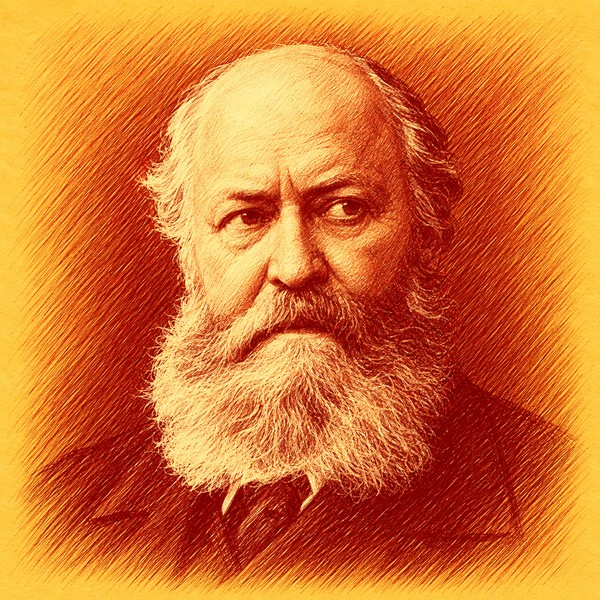
Charles Gounod (1818–1893) was born in Paris into an artistic family and studied at the Paris Conservatoire with Fromental Halévy and Jean-François Le Sueur. In 1839 he won the Prix de Rome, and his years in Italy deepened his admiration for Palestrina and sacred music. For a time Gounod considered entering the priesthood, but he ultimately chose a professional musical career. After several uncertain operatic beginnings, he became one of the dominant figures of French opera in the 1850s and 1860s. He spent part of the Franco-Prussian War period in England before returning permanently to France, where sacred composition occupied much of his later life.
Gounod’s international reputation rests above all on Faust, whose lyrical refinement and dramatic immediacy made it one of the most frequently performed operas of the nineteenth century. Roméo et Juliette likewise remains central to the French operatic repertory, while Mireille contains some of his most distinctive music. His sacred works include numerous masses and motets, and his famous Ave Maria superimposes a flowing melody over the Prelude in C major from Bach’s Well-Tempered Clavier. Gounod’s elegant melodic style and sensitive treatment of the voice influenced a younger generation of French composers, including Bizet and Massenet.

###
Gounod, Charles (François) (b Paris, 1818; d St-Cloud, 1893). Fr. composer, conductor, and organist. Won Grand Prix de Rome 1839; impressed by Rome and made special study of Palestrina. Became org. at Paris church and studied for priesthood but eventually decided to devote himself to comp. Wrote several operas from 1851 but had no real success until Faust in 1859, which became and remained one of the most popular of all operas. Later operas were less successful, though Roméo et Juliette survives and the delightful La Colombe has been rediscovered. Also wrote many choral works and lived in Eng. 1870-5, becoming first cond. of what is now Royal Choral Soc. His oratorios La Rédemption and Mors et vita were comp. for the Birmingham and Norwich Fests. of 1882 and 1885. Gounod's mus. has considerable melodic charm and felicity, with admirable orchestration. He was not really a master of the large and imposing forms, in this way perhaps being a Fr. parallel to Sullivan. Works incl.:
OPERAS: Sapho (1851); La Nonne sanglante (1854); Le Médecin malgré lui (1858); Faust (1859); La Colombe (1860); Philémon et Baucis (1860); La Reine de Saba (1862); Mireille (1864); Roméo et Juliette (1867); Cinq Mars (1877); Polyeucte (1878); Le Tribut de Zamora (1881).
ORCH.: sym. No.1 in D (1855), No.2 in Eb (c.1854); Petite Symphonie in Bb, for 9 wind instrs. (1885).
ORATORIOS: La Rédemption (1868-81); Mors et Vita (1885).
CANTATAS: Marie Stuart (1837); Gallia (1871).
CHURCH MUSIC: Messe a tre (1841); Messe solennelle (1849); Messe solennelle de Ste Cécile (1855); Messe à Jeanne d'Arc (1887); three Requiems; Stabat Mater, Te Deum, Magnificat, etc.
MISC.: Funeral March of a Marionette (for pf., 1872, orch. 1879); Méditation sur le premier prélude de S. Bach, pf., vn. or vc., org. or vc. ad lib (1853, being 1st prelude of Bach's ‘48’ with counterpoint melody by Gounod. In 1859 this was arr. as a solo song, Ave Maria, mélodie religieuse adaptée au premier prélude de J. S. Bach); many songs.
Copyright © 1996 Oxford University Press - By permission of Oxford University Press
###
Read biography at allmusic.com.
|
|
Charles Gounod (1818–1893) was born in Paris into an artistic family and studied at the Paris Conservatoire with Fromental Halévy... More
|
 Files of this type are not available at this time. Please select ALL from above.
 Click on a category to view the list of works
-
Stage Works
27 midis
- Operas
19 midis
- Faust (opéra)
19 midis
- Faust (opéra)
-
Ballets
8 midis
- Operas
-
Vocal Works
9 midis
- Songs (includes Bach-Gounod, Ave Maria)
7 midis
-
Choral Works
2 midis
- Songs (includes Bach-Gounod, Ave Maria)
-
Orchestral Works
4 midis
- Symphonies
2 midis
-
Other Orchestral Works
2 midis
- Symphonies
-
Chamber Works
1 midi
-
Stage Works
27 midis
- Operas
19 midis
- Faust (opéra)
19 midis
- Faust (opéra)
-
Ballets
8 midis
- Operas
-
Vocal Works
9 midis
- Songs (includes Bach-Gounod, Ave Maria)
7 midis
-
Choral Works
2 midis
- Songs (includes Bach-Gounod, Ave Maria)
-
Orchestral Works
4 midis
- Symphonies
2 midis
-
Other Orchestral Works
2 midis
- Symphonies
-
Chamber Works
1 midi