Composer (MIDI)
Orlando di Lasso (c. 1532-1594); FLM
 Loading, please wait...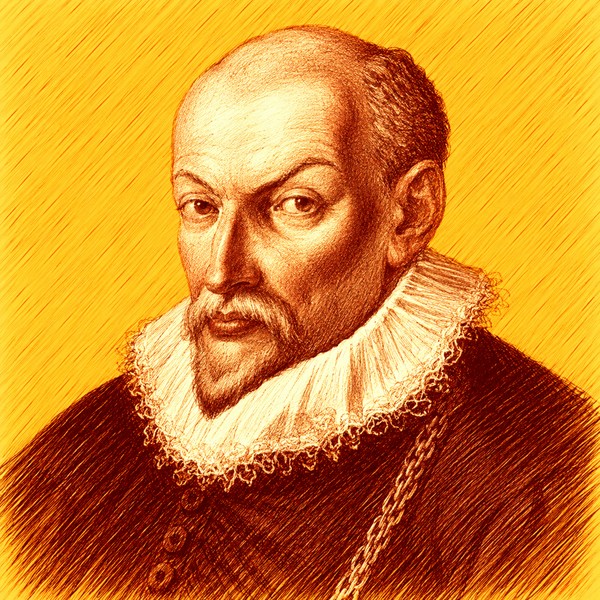
Orlande de Lassus (c.1532–1594), also known as Orlando di Lasso, was born in Mons in the Habsburg Netherlands and became one of the most celebrated composers of the late Renaissance. As a boy singer he traveled to Italy, where he worked in Mantua, Naples, and Rome and in 1553 became maestro di cappella at the Basilica of St. John Lateran. After a period in Antwerp, he entered the service of Duke Albrecht V of Bavaria in Munich, eventually becoming Kapellmeister. He remained associated with the Bavarian court for the rest of his life, achieving international fame and receiving honors from both imperial and papal authorities.
Lassus was extraordinarily prolific and versatile, composing more than two thousand works in virtually every important vocal genre of his time: masses, motets, magnificats, hymns, chansons, madrigals, and German Lieder. His sacred works range from concise liturgical settings to intensely expressive compositions such as the cycle Prophetiae Sibyllarum and his final collection, Lagrime di San Pietro. His secular music displays equal command of French, Italian, and German traditions. Together with Palestrina, Lassus stands as one of the defining masters of late Renaissance polyphony, admired for expressive text setting, contrapuntal fluency, and exceptional stylistic range.

###
Read biography at allmusic.com.
|
|
Orlande de Lassus (c.1532–1594), also known as Orlando di Lasso, was born in Mons in the Habsburg Netherlands and became... More
|
 Files of this type are not available at this time. Please select ALL from above.
 Click on a category to view the list of works
-
Sacred Vocal Works
4 midis
-
Motets
4 midis
- Musica Dei donum optimi (a6), M.xvi (S.xix/63)
1 midi
- Salve regina mater (a6)
1 midi
- Tristis est anima mea (a5)
2 midis
- Musica Dei donum optimi (a6), M.xvi (S.xix/63)
-
Motets
-
Secular Vocal Works
16 midis
- Chansons
7 midis
- J’ay cherché la science (a4)
1 midi
- La nuit froide et somber (a4)
1 midi
- Mon Coeur se recommande, chanson for 5 voices, B. xiii/15 (S. xiv/15)
1 midi
- O doux parler (a8)
1 midi
- Petite folle (a4)
1 midi
- Quand mon mary vient (a4)
1 midi
- Que dis-tu (Ronsard), chanson for 8 voices, B. xiii/142 (S. xiv/142)
1 midi
- J’ay cherché la science (a4)
-
Villanelle
6 midis
- Audite nova (a4)
1 midi
- Io ti vorria contar (a4)
1 midi
- Matona mia cara (villanelle, a4) S.x/93
2 midis
- O la o che bon eccho (a8)
2 midis
- Audite nova (a4)
-
Lieder
3 midis
- Chansons
-
Sacred Vocal Works
4 midis
-
Motets
4 midis
- Musica Dei donum optimi (a6), M.xvi (S.xix/63)
1 midi
- Salve regina mater (a6)
1 midi
- Tristis est anima mea (a5)
2 midis
- Musica Dei donum optimi (a6), M.xvi (S.xix/63)
-
Motets
-
Secular Vocal Works
16 midis
- Chansons
7 midis
- J’ay cherché la science (a4)
1 midi
- La nuit froide et somber (a4)
1 midi
- Mon Coeur se recommande, chanson for 5 voices, B. xiii/15 (S. xiv/15)
1 midi
- O doux parler (a8)
1 midi
- Petite folle (a4)
1 midi
- Quand mon mary vient (a4)
1 midi
- Que dis-tu (Ronsard), chanson for 8 voices, B. xiii/142 (S. xiv/142)
1 midi
- J’ay cherché la science (a4)
-
Villanelle
6 midis
- Audite nova (a4)
1 midi
- Io ti vorria contar (a4)
1 midi
- Matona mia cara (villanelle, a4) S.x/93
2 midis
- O la o che bon eccho (a8)
2 midis
- Audite nova (a4)
-
Lieder
3 midis
- Chansons