Composer (MIDI)
Modest Petrovich Mussorgsky (1839-1881); RUS
 Loading, please wait...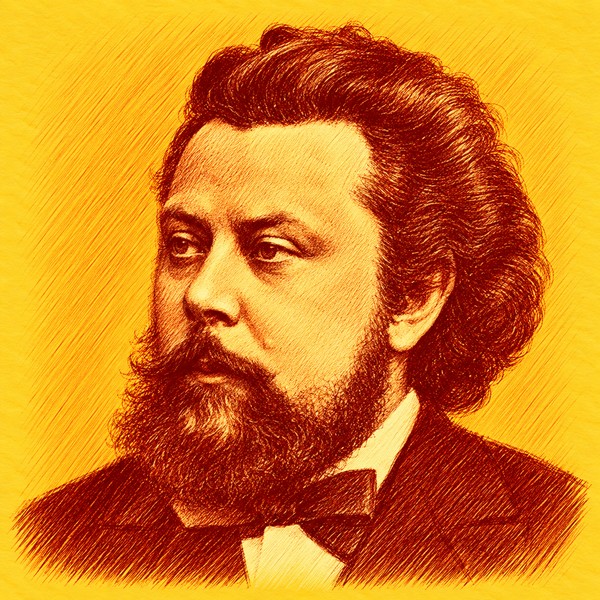
Modest Petrovich Mussorgsky (1839–1881) was a Russian composer born at Karevo in the Pskov region. Initially trained for a military career, he entered the elite Preobrazhensky Guards but resigned his commission in 1858 to devote himself increasingly to music. Through Mily Balakirev he became associated with the circle later known as “The Five,” whose members sought to develop a distinctively Russian national style independent of academic European models. Financial difficulties and alcoholism increasingly troubled his later years, and he died in St Petersburg at forty-two.
Mussorgsky’s music is distinguished by bold harmony, sharply characterized rhythm, and an unusually direct response to Russian speech and folk idioms. His masterpiece is the opera Boris Godunov; other major works include the piano cycle Pictures at an Exhibition, the orchestral tone poem Night on Bald Mountain, and the song cycles The Nursery, Sunless, and Songs and Dances of Death. Several works were left unfinished or later revised and orchestrated by other composers, but his uncompromising musical language profoundly influenced later Russian and European modernism.

###
Mussorgsky, Modest (Petrovich) (b Karevo, Pskov, 1839; d St Petersburg, 1881). Russ. composer. Showed mus. talent as a child but was destined for an army career. In 1857 he met Balakirev in St Petersburg and studied with him, resigning his commission the next year. His early songs and pf. pieces show little sign of his later achievement, but by 1864 he was writing fine songs. He started and abandoned 2 operas, but began work in 1868 on Boris Godunov, which he rev. when it was rejected by the Imperial Th. On its prod. in 1874 it pleased audiences but not musicians, who resented its unconventional methods and unusual style in which speech-inflexion governed the vocal lines. Over the next few years Mussorgsky worked on 2 operas, but his heavy drinking, a habit acquired at cadet school, sapped his capacity for concentrated work. He was one of the group of 5 Russ. composers of nationalist tendencies known as the ‘Mighty handful’. After his death his works were completed and ‘improved’ by Rimsky-Korsakov and others, but in the 20th cent. his realistic and progressive qualities have been recognized and his orig. scores have been restored where possible. Prin. comps.:
OPERAS: Salammbô (unfinished, 1863-6); The Marriage (1 act only finished) (1868); Boris Godunov (1868-9, rev. 1871-2, rev. 1873); Mlada (projected 4-act opera-ballet of which Cui, Rimsky-Korsakov, and Borodin were to compose the other 3 acts, 1872); Khovanshchina (1873, 5th act unfinished); Sorochintsy Fair (1876-81, unfinished).
ORCH.: Night on the Bare Mountain (1867, rev. 1872, 1874).
PIANO: Souvenir d'Enfance (1857); Intermezzo (1861, orch. and expanded 1867); Memories of Childhood (1865); Pictures at an Exhibition (1874).
SONGS: Many solo songs and 3 song-cycles: The Nursery (7 songs) (1868-72); Sunless (6 songs) (1874); Songs and Dances of Death (4 songs) (1875-7). (The famous Song of the Flea dates from 1879.)
Copyright © 1996 Oxford University Press - By permission of Oxford University Press
###
Read biography at allmusic.com.
|
|
Modest Petrovich Mussorgsky (1839–1881) was a Russian composer born at Karevo in the Pskov region. Initially trained for a military... More
|
 Files of this type are not available at this time. Please select ALL from above.
 Click on a category to view the list of works
-
Stage Works
3 midis
-
Piano Works (includes Pictures at an Exhibition)
84 midis
- Albumleaf: Meditation
1 midi
- Pictures at an Exhibition (Kartinki s vïstavski)
80 midis
- Sonata in C, for piano 4-hands
3 midis
- Albumleaf: Meditation
-
Orchestral Works
4 midis
-
Vocal Works
3 midis
-
Songs and Song Cycles
3 midis
-
Songs and Song Cycles
-
Stage Works
3 midis
-
Piano Works (includes Pictures at an Exhibition)
84 midis
- Albumleaf: Meditation
1 midi
- Pictures at an Exhibition (Kartinki s vïstavski)
80 midis
- Sonata in C, for piano 4-hands
3 midis
- Albumleaf: Meditation
-
Orchestral Works
4 midis
-
Vocal Works
3 midis
-
Songs and Song Cycles
3 midis
-
Songs and Song Cycles