Composer (MIDI)
Niccolò Paganini (1782-1840); ITA
 Loading, please wait...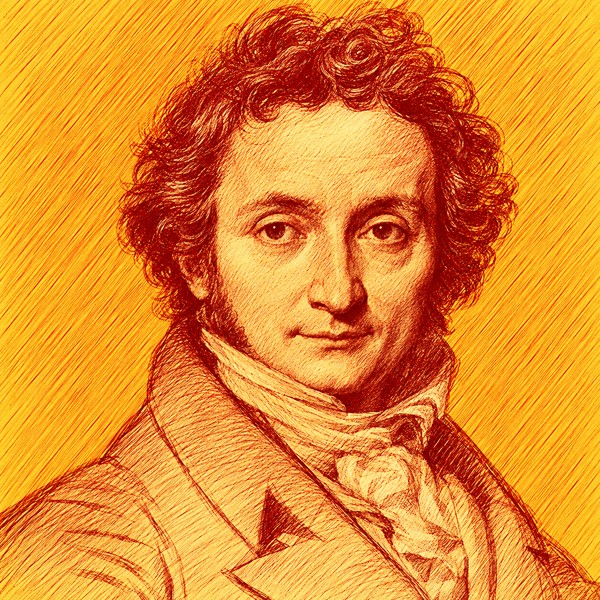
Niccolò Paganini (1782–1840) was an Italian violinist and composer born in Genoa. Trained first by his father and local teachers, he displayed exceptional gifts at an early age and developed a performing technique of unprecedented virtuosity. After employment at the court of Lucca, he embarked on an international concert career that made him one of Europe’s most famous musicians. His extraordinary stage presence and technical feats transformed public expectations of the virtuoso soloist.
Paganini’s compositions were closely linked to his own phenomenal technique, exploiting harmonics, rapid passagework, multiple stops, left-hand pizzicato, unusual bowing, and extreme registers. His 24 Caprices for Solo Violin remain central to the violin repertory, particularly Caprice No. 24. He also wrote six violin concertos, including the celebrated Violin Concerto No. 1, as well as chamber works involving guitar. His example profoundly influenced Liszt and the Romantic cult of instrumental virtuosity.

###
Paganini, Niccolò (b Genoa, 1782; d Nice, 1840). It. violinist and composer. Regarded as greatest of all vn. virtuosos. Made first tour at 13 and comp. difficult pieces for himself to play. During a love affair in 1801-4 he took up the guitar, for which he composed 6 str. qts. with a guitar part, and other works. Returned to platform 1805 with sensational success. Dir. of mus. to Princess of Lucca 1805-9. Milan début 1813, Vienna 1828, Paris and London 1831. In Paris in 1833 commissioned va. conc. from Berlioz, the result being Harold en Italie, but he never played it. From 1834 he made few appearances: for some years he had been suffering from cancer of the larynx which killed him in 1840. He left a fortune and was generous to colleagues in need. Owned vns. by Stradivarius, Guarnerius, and Amati, also Stradivarius va. and db. His Mephistophelean appearance led to stories that his virtuosity stemmed from diabolical powers; he was a skilled showman and although his feats as a virtuoso are no longer regarded as unique or unapproachable, he pioneered the use of harmonics, tuned his instr. to obtain special effects, used several styles of bowing, and exploited staccato and pizzicato as never before. His intonation was unfailingly accurate. Works incl.:
VN. CONCS.: No.1 in Eb (usually played in D) (?1817), No.2 in B minor, with Rondo à la clochette (1826), No.3 in E major (1826), No.4 in D minor (1830), No.5 in A minor (1830), and the so-called No.6 in E minor (comp. c.1815) (and others lost).
VN. AND ORCH.: Le Streghe (Witches' Dance) based on air by Süssmayer; Variations on God Save the King; Moto perpetuo, allegro de concert; Variations on Non più mesta (La Cenerentola); Variations on the air Di tanti palpiti (Tancredi).
VC. AND ORCH.: Variations on Theme of Rossini for 2 vc.
SOLO VN.: 24 Caprices (c.1805); Variations on Le Carnaval de Venise; Duo in C; Recitative and Variations on 3 airs for the 4th string.
CHAMBER MUSIC: 12 sonatas for vn. and guitar; 6 qts. for vn., va., guitar, and vc.; vn. sonata with vn. and vc. acc.; Terzettos for vn., vc., guitar; 3 str. qts. (1800-5).
Copyright © 1996 Oxford University Press - By permission of Oxford University Press
###
Read biography at allmusic.com.
|
|
Niccolò Paganini (1782–1840) was an Italian violinist and composer born in Genoa. Trained first by his father and local teachers,... More
|
 Files of this type are not available at this time. Please select ALL from above.
 Click on a category to view the list of works
-
Concertos and Related Works
6 midis
- Violin Concertos
4 midis
-
Variations for Violin and Orchestra
1 midi
-
Other Works
1 midi
- Violin Concertos
-
Chamber Works
46 midis
- Works for Solo Violin
35 midis
-
Violin and Guitar Duets
7 midis
- 6 Sonatas for Violin and Guitar, Op.2
1 midi
-
6 Sonatas for Violin and Guitar, Op.3
2 midis
-
Other Violin and Guitar Works
4 midis
- 6 Sonatas for Violin and Guitar, Op.2
-
Works for Guitar Solo
2 midis
-
Other Works for Guitar Solo
2 midis
- 43 Ghiribizzi, MS43
2 midis
- 43 Ghiribizzi, MS43
-
Other Works for Guitar Solo
-
Other Chamber Works
2 midis
- Cantabile in D, for violin and piano, MS109, Op.17
1 midi
- Trio in D
1 midi
- Cantabile in D, for violin and piano, MS109, Op.17
- Works for Solo Violin
-
Concertos and Related Works
6 midis
- Violin Concertos
4 midis
-
Variations for Violin and Orchestra
1 midi
-
Other Works
1 midi
- Violin Concertos
-
Chamber Works
46 midis
- Works for Solo Violin
35 midis
-
Violin and Guitar Duets
7 midis
- 6 Sonatas for Violin and Guitar, Op.2
1 midi
-
6 Sonatas for Violin and Guitar, Op.3
2 midis
-
Other Violin and Guitar Works
4 midis
- 6 Sonatas for Violin and Guitar, Op.2
-
Works for Guitar Solo
2 midis
-
Other Works for Guitar Solo
2 midis
- 43 Ghiribizzi, MS43
2 midis
- 43 Ghiribizzi, MS43
-
Other Works for Guitar Solo
-
Other Chamber Works
2 midis
- Cantabile in D, for violin and piano, MS109, Op.17
1 midi
- Trio in D
1 midi
- Cantabile in D, for violin and piano, MS109, Op.17
- Works for Solo Violin