Composer (MIDI)
Max Reger (1873-1916); DEU
 Loading, please wait...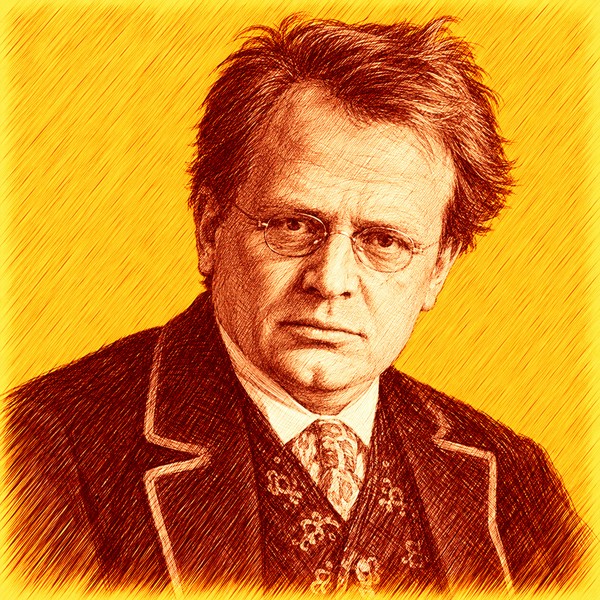
Max Reger (1873–1916) was a German composer, organist, pianist, conductor, and teacher born in Brand, Bavaria. He studied with Hugo Riemann and later worked in Munich, Leipzig, and Meiningen, where he succeeded to the conducting tradition associated with the celebrated court orchestra. Reger taught composition at the Leipzig Conservatory and was renowned both for his prodigious productivity and for an intensely contrapuntal musical language rooted in Bach and Brahms.
Reger composed extensively for organ, piano, chamber ensembles, orchestra, and choir. Important works include the Variations and Fugue on a Theme by Mozart, Variations and Fugue on a Theme by Hiller, Fantasy and Fugue on B-A-C-H, and numerous chorale fantasias and sonatas for organ. His music combines dense chromatic harmony with Baroque contrapuntal forms, creating a distinctive bridge between late Romanticism and the harmonic and structural experiments of the early twentieth century.

###
Reger, (Johann Baptist Joseph) Max(imilian) (b Brand, 1873; d Leipzig, 1916). Ger. composer, pianist, organist, and teacher. Wrote most of his org. works by 1900, finding devoted interpreter in Karl Straube. Lived in Munich from 1901, teaching at Acad. of Mus. 1905-6. Dir. of mus. and prof. of comp., Leipzig Univ. 1907-11. Cond., Meiningen Orch. 1911-14. Toured Europe and Russia as organist. Was opponent of ‘programme’ mus. and comp. only in ‘absolute’ forms. Master of polyphony and developed complex harmonic procedures. Prolific composer, chief works incl.:
ORCH.: 2 Romances, vn., orch. (1900); Variations and Fugue on a Theme of Beethoven (1915, arr. of 2-pf. work 1904); Sinfonietta in A (1904-5); Serenade in G (1905-6); Variations and Fugue on a Theme of J. A. Hiller (1907); vn. conc. in A (1907-8); Symphonic Prologue for a Tragedy in A minor (1908); pf. conc. in F minor (1910); Comedy Overture (1911); Concerto in Olden Style (1912); Romantic Suite, after Eichendorff (1912); 4 Böcklin Tone-Pictures (1913); Ballet Suite in D (1913); Variations and Fugue on a Theme of Mozart (1914, arr. for 2 pf. 1914).
CHORAL: Hymne an den Gesang, male ch., orch. (1898); 7 Male Choruses (1899); 4 Cantatas (1903-5); 10 Gesänge, male vv. (1904, 1909); Psalm 100, ch., orch., org. (1908-9); Geistliche Gesänge, 5 vv. (1912); Die Weihe der Nacht, male vv., orch. (1911); Römischer Triumphgesang, male vv., orch. (1912).
VOCAL: An die Hoffnung, alto, orch. or pf. (1912); Hymnus der Liebe, bar. or alto, orch. (1914); 12 Sacred Songs, v., pf. or org. or harmonium (1914); also over 250 solo songs, 12 of them with orch. acc.
CHAMBER MUSIC: 6 str. qts. (1888-9, 1900 (2), 1903-4, 1909, 1911); 2 pf. quintets (1897-8, 1901-2); 9 vn. sonatas (1890, 1891, 1892, 1903, 1904, 1905, 1910, 1911, 1915); 3 vc. sonatas (1898, 1904, 1910); 11 sonatas for solo vn. (1900 (4), 1905 (7)); 3 cl. sonatas (1900 (2), 1908-9); 2 pf. qts. (1910, 1914); str. sextet (1910); cl. quintet (1915);
PIANO: 12 Waltz-Caprices, duet (1892); 7 Waltzes (1893); Lose Blätter (1894); 6 Morceaux (1898); 7 Fantasie-Stücke (1898); 7 Charakterstücke (1899); 6 Intermezzi (1900); 7 Silhouettes (1900); 12 Blätter und Blüten (1900-2); 10 Pieces (1901-3); Variations and Fugue on a Theme of J. S. Bach (1904); Aus meinen Tagebuch (35 little pieces) (1904-12); Variations and Fugue on a Theme of Beethoven, 2 pf. (1904, orch. 1915); 4 Pieces (1901-6); 4 Sonatinas (1905, 1908); Introduction, Passacaglia, and Fugue, 2 pf. (1906); Variations and Fugue on a Theme of Mozart, 2 pf. (1914, arr. of orch. work); Variations and Fugue on a Theme of G. P. Telemann (1914); Träume am Kamin, 12 little pieces (1915).
ORGAN: 3 Pieces (1892); Chorale Fantasia ‘Ein’ feste Burg’ (1898); Fantasia and Fugue in C minor (1898); Sonatas, No.1 in F# (1899), No.2 in D minor (1901); Fantasia and Fugue on BACH (1900); 6 Trios (1900); 5 Easy Preludes and Fugues (1904); 12 Pieces (1901); 12 Pieces (1902); 52 Easy Chorale Pieces (1902); 10 Pieces (1903); Variations and Fugue on an Original Theme in F# (1903); 13 Chorale Preludes (1901-3); 12 Pieces (1904); 4 Preludes and Fugues (1904); Introduction, Passacaglia, and Fugue in E minor (1913); 9 Pieces (1913); 30 Little Chorale Preludes (1914); Fantasia and Fugue in D minor (1916); 7 Pieces (1915-16).
Copyright © 1996 Oxford University Press - By permission of Oxford University Press
###
Read biography at allmusic.com.
|
|
Max Reger (1873–1916) was a German composer, organist, pianist, conductor, and teacher born in Brand, Bavaria. He studied with Hugo... More
|
 Files of this type are not available at this time. Please select ALL from above.
 Click on a category to view the list of works
-
Keyboard Works
10 midis
- Piano Works
1 midi
- 10 Piano Pieces, Op.79a
1 midi
- 10 Piano Pieces, Op.79a
-
Organ Works
9 midis
- Fantasie und Fuge in D-, Op.135b
3 midis
- Introduction, Passacaglia and Fugue in E-, Op.127
1 midi
- 9 Pieces, Op.129
5 midis
- Fantasie und Fuge in D-, Op.135b
- Piano Works
-
Chamber Works
6 midis
-
Other Chamber Works
6 midis
-
Other Chamber Works
-
Vocal Works
1 midi
-
Choral Works
1 midi
-
Choral Works
-
Keyboard Works
10 midis
- Piano Works
1 midi
- 10 Piano Pieces, Op.79a
1 midi
- 10 Piano Pieces, Op.79a
-
Organ Works
9 midis
- Fantasie und Fuge in D-, Op.135b
3 midis
- Introduction, Passacaglia and Fugue in E-, Op.127
1 midi
- 9 Pieces, Op.129
5 midis
- Fantasie und Fuge in D-, Op.135b
- Piano Works
-
Chamber Works
6 midis
-
Other Chamber Works
6 midis
-
Other Chamber Works
-
Vocal Works
1 midi
-
Choral Works
1 midi
-
Choral Works