Composer (MIDI)
Nikolai Andreyevich Rimsky-Korsakov (1844-1908); RUS
 Loading, please wait...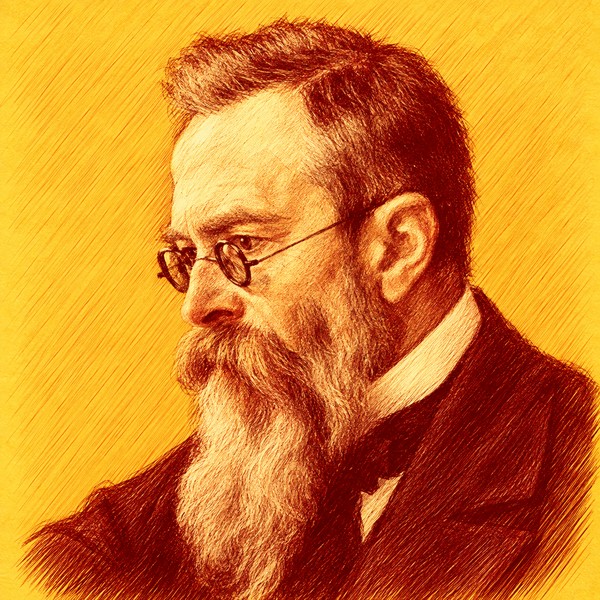
Nikolai Rimsky-Korsakov (1844–1908) was a Russian composer, teacher, and naval officer born in Tikhvin. Initially trained for a naval career, he became associated with Mily Balakirev and the nationalist group of composers later called “The Five.” Despite limited formal training, he was appointed professor at the St Petersburg Conservatory in 1871 and undertook an intensive self-education in harmony and counterpoint. He subsequently became one of Russia’s most influential composition teachers, numbering Glazunov, Lyadov, and Stravinsky among those shaped by his work.
Rimsky-Korsakov was a master of orchestration and musical color, often drawing on Russian folklore, exotic subjects, and fairy tales. His best-known works include the symphonic suite Scheherazade, Capriccio espagnol, and the Russian Easter Festival Overture, as well as operas such as The Snow Maiden, Sadko, The Tale of Tsar Saltan, and The Golden Cockerel. His orchestration treatise and teaching had an enduring impact on twentieth-century composers.

###
Rimsky-Korsakov, Nikolay (Andreyevich) (b Tikhvin, 1844; d Lyubensk, 1908). Russ. composer and cond. Born into aristocratic family and had conventional mus. education. Ambition to be sailor; entered Corps of Naval Cadets 1856 in St Petersburg, where he had pf. lessons and attended opera and concerts. Nationalist works of Glinka deeply impressed him and he met and was influenced by Balakirev. Wrote part of a sym., though ignorant of names of chords and of rules of part-writing. Away at sea 1862-5. Completed sym. 1865, first of importance by Russ. composer. In 1865-8 wrote Sadko and Antar, both later rev. In 1869 was entrusted with completion of Dargomyzhsky's opera The Stone Guest and in 1872 completed his own opera The Maid of Pskov. In 1871, while still a naval lieutenant and still unlearned in harmony and counterpoint, was appointed prof. of practical comp. and instrumentation, St Petersburg Cons. Taught himself in secret. Inspector of Naval Bands, 1873-84. For several years as part of his self-education prod. ‘academic’ comps. incl. str. qt., pf. quintet, pf. fugues, etc. His editing of 100 Russian Folk-Songs, 1876-7, led him to a new, more attractive phase in his own works, incl. the operas May Night and Snegurochka (The Snow Maiden). From 1874-81 was dir. of the Free School of Mus. After 1882 much occupied with administration, cond., and rev. and orchestration of Khovanshchina and other works by Mussorgsky. When Borodin died in 1887, completion and orch. of Prince Igor was undertaken by Rimsky-Korsakov and his pupil Glazunov. Rimsky interrupted this to write 2 of his most colourful works, the Spanish Caprice and Sheherazade. Thereafter, influenced by the first Russ. perfs. in 1888-9 of Wagner's Ring, devoted himself to opera. For a time, neurasthenic illness robbed him of the will to work, but he resumed creative work in the 1890s and in 1896 made his version of Mussorgsky's Boris Godunov which, though it is now partly discredited, preserved this opera until scholars restored the composer's orig. In 1905, having shown sympathy with revolutionary students, was temporarily removed from his professorship at St Petersburg Cons. and a 2-month ban imposed on perf. of his works. This clash with authority is reflected in his last and satirical opera, The Golden Cockerel, which was banned by the govt. and not prod. until after his death. In 1906, rev. Boris Godunov, and in 1907 cond. in Paris at Diaghilev's concerts of Russ. mus.
Less talented than his colleagues in the nationalist school, Rimsky-Korsakov excelled them all in the art of clear and colourful orchestration, and to us today his mus. seems to epitomize the brilliance and pageantry of Tsarist Russia. Lately the splendour of his operas has been re-discovered. His influence on his most distinguished pupil, Stravinsky, can be discerned above all in The Firebird. Wrote textbooks on harmony and orchestration, also autobiography. Prin. comps.:
OPERAS: The Maid of Pskov (Ivan the Terrible) (1868-72, rev. 1876-7, rev. 1891-2); May Night (1878-9); Snow Maiden (Snegurochka) (1880-1, rev. c.1895); Mlada (1889-90); Christmas Eve (1894-5); Sadko (1894-6); Mozart and Salieri (1897); Boyarina Vera Sheloga (comp. 1876-7 as prol. to Maid of Pskov, reconstructed as 1-act opera 1898); The Tsar's Bride (1898); The Legend of Tsar Saltan (1899-1900); Servilia (1900-1); Kashchey the Immortal (1901-2, rev. 1906); Pan Voyevoda (1902-3); Legend of the Invisible City of Kitezh and the Maiden Fevronia (1903-5); The Golden Cockerel (1906-7).
ORCH.: syms.: No.1 in Eb minor (1861-5, rev. in E minor 1884), No.2 (Antar, 1868, rev. 1876 and 1897, symphonic suite 1903), No.3 in C (1866-73, rev. 1885-6); Overture on 3 Russian Themes (1866, rev. 1879-80); Fantasia on Serbian Themes (1867, reorch. 1886-7); Sadko, symphonic picture (1867, rev. 1869, 1891; see also opera); conc., tb., military band (1877); Sinfonietta on Russian Themes, str. qt. (1897; rev. and orch. 1880-4); Skazka (Legend) (1879-80); pf. conc. (1882-3); Fantasia on Russian Themes, vn., orch. (1886); Spanish Caprice (1887); Sheherazade (1888); Russian Easter Festival Overture (1888); Dubinushka (1905).
CHORAL: Alexey the Man of God, ch., orch. (1877); Svitezyanka, cantata (1897); Song of Oleg the Wise, cantata (1899); From Homer (1901).
CHAMBER MUSIC: str. qt. (1875); str. sextet (1876); pf. quintet (pf., wind) (1876); Allegro in Bb, str. qt. (1899)
TRANSCRIPTIONS etc.: BORODIN: Prince Igor, orch. and completed (with Glazunov), prod. 1890; MUSSORGSKY: Boris Godunov, re-orch. 1896, rev. 1906, Khovanshchina, rev. and orch. 1882-5; DARGOMYZHSKY: The Stone Guest, orch. and completed 1870-1, rev. 1902.
Also songs, chs., folk-song arrs. and pf. pieces.
Copyright © 1996 Oxford University Press - By permission of Oxford University Press
###
Read biography at allmusic.com.
|
|
Nikolai Rimsky-Korsakov (1844–1908) was a Russian composer, teacher, and naval officer born in Tikhvin. Initially trained for a naval career,... More
|
 Files of this type are not available at this time. Please select ALL from above.
 Click on a category to view the list of works
-
Stage Works (includes 'Flight of the Bumblebee')
13 midis
-
Orchestral Works
22 midis
- Symphonies and Other Related Works
3 midis
-
Suites
12 midis
-
Works for Military Band
5 midis
-
Other Orchestral Works
2 midis
- Symphonies and Other Related Works
-
Vocal Works
8 midis
- Songs
8 midis
- Collection of 100 Russian Songs, Op.24
5 midis
- 4 Songs, Op.3
1 midi
- 2 Songs, Op.49 (baritone)
2 midis
- Collection of 100 Russian Songs, Op.24
- Songs
-
Stage Works (includes 'Flight of the Bumblebee')
13 midis
-
Orchestral Works
22 midis
- Symphonies and Other Related Works
3 midis
-
Suites
12 midis
-
Works for Military Band
5 midis
-
Other Orchestral Works
2 midis
- Symphonies and Other Related Works
-
Vocal Works
8 midis
- Songs
8 midis
- Collection of 100 Russian Songs, Op.24
5 midis
- 4 Songs, Op.3
1 midi
- 2 Songs, Op.49 (baritone)
2 midis
- Collection of 100 Russian Songs, Op.24
- Songs