Composer (MIDI)
Heitor Villa-Lobos (1887-1959); BRA
 Loading, please wait...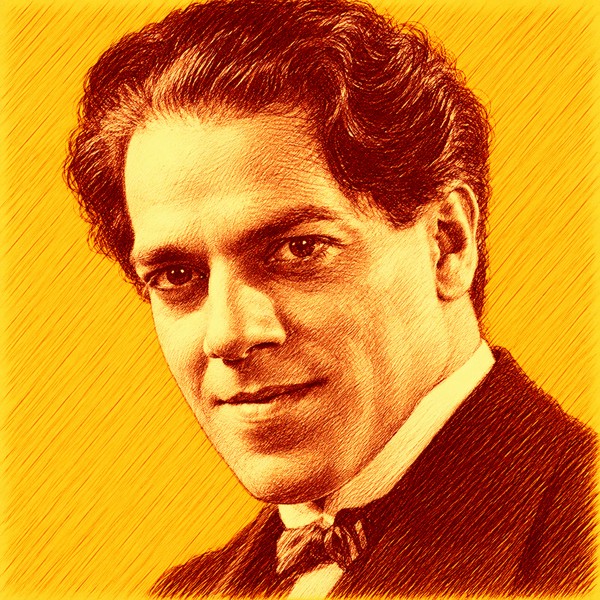
Heitor Villa-Lobos (1887–1959) was a Brazilian composer, conductor, and educator born in Rio de Janeiro. Trained partly by his father and largely self-directed thereafter, he absorbed the music of Brazilian popular and folk traditions alongside the European classical repertory. His travels within Brazil became an important part of his artistic self-image, while extended stays in Paris during the 1920s brought him into contact with the European avant-garde. He later played a major role in Brazilian music education and cultural policy.
Villa-Lobos created a vast catalogue that fused Brazilian musical materials with highly individual approaches to harmony, rhythm, form, and instrumental color. His best-known works include the series Chôros and Bachianas Brasileiras, the latter combining Brazilian idioms with an homage to Bach. His output also includes symphonies, concertos, string quartets, piano music, songs, and a substantial guitar repertory, including Five Preludes and Twelve Études. He became the most internationally prominent Brazilian classical composer of the twentieth century.

###
Villa-Lobos, Heitor (b Rio de Janeiro, 1887; d Rio de Janeiro, 1959). Brazilian composer. First mus. lessons from father, who taught him vc. Had harmony lessons 1907, otherwise self-taught, earning living by playing in cafés, etc. Played vc. in Rio opera and sym. orchs., absorbing influences from Russ. nationalists, Stravinsky, and Strauss, under whose baton he played in 1920. Befriended by Milhaud when latter was Claudel's secretary at Fr. embassy, and by Arthur Rubinstein, 1921, who played his pf. mus. Spent 1923-4 in Europe and 1927-30 in Paris where he was influenced by Satie and Milhaud and by fashionable neoclassicism. Result was series of works called Bachianas Brasileiras in which Baroque forms were re-created with Brazilian ‘local colour’. Returning to Brazil 1930, held series of official teaching posts. Founded Conservatório Nacional de Canto Orfeónico 1942 and Brazilian Acad. of Mus., 1945 (pres. 1945-59). Visited USA 1944 as cond. of own mus. Extremely prolific composer, with expected sharp variations in quality. Though his mus. suggests the folk idiom, he rarely, if ever, quoted a folk-song, relying instead on colour and rhythm to give Brazilian flavour. Melodist and romantic, he used the popular chôro form as a basis for series of works for various combinations of instr. and vv. with specific nationalist intent. Prin. works incl.:
OPERAS: Izaht (1912-14); Yerma (1955-6).
CHÔROS: No.1, gui, (1920); No.2, fl., cl. (1924); No.3, 7 winds, male ch. (1925); No.4, 2 hn., tb. (1926); No.5, pf. (1926); No.6, orch. (1926); No.7, 5 winds, vn., vc. (1924); No.8, 2 pf., orch. (1925); No.9, orch. (1929); No.10, orch., ch. (1925); No.11, pf., orch. (1928); No.12, orch. (1929); No.13, 2 orchs., band (1929); No.14, orch., band, ch. (1928). Also Chôros bis, vn., vc. (1928)
BACHIANAS BRASILEIRAS: 1. 8 vc. (1930); 2. The Little Train of the Caipira, chamber orch. (1934); 3. pf., orch. (1934); 4. pf. (1930-40) or orch. (1941); 5. v., 8 vcs. (1938); 6. fl., bn. (1938); 7. orch. (1942); 8. orch. (1944); 9. unacc. ch. or str. (1944).
ORCH.: syms.: No.1 (1916), No.2 (1917), Nos. 3 and 4 (1919), No.5 (1920)—Nos. 3, 4, and 5 are a World War I trilogy, subtitled respectively ‘Guerra’, ‘Vitória’, and ‘Paz’—No.6 (Montanhas do Brasil) (1944), No.7 (Odisséia da paz) (1945), No.8 (1950), No.9 (1951), No.10 (Sume pater patrium), soloists, ch., orch. (1952), No.11 (1955), No.12 (1957); Suite Suggestive No.1 (1929); 4 Suites, Descrobimento di Brasil (Discovery of Brazil) (1936-7, 1942); New York Skyline (1940); vc. concs., No.1 (1915), No.2 (1953); 5 pf. concs. (1945-54); gui. conc. (1951); hp. conc. (1953); harmonica conc. (1955).
CHAMBER MUSIC: 17 str. qts. (1915-58); 3 pf. trios (1911-18); 4 vn. sonatas (1912-23); Berceuse (1915); 2 vc. sonatas (1915, 1916); Nonet (1923); Sextetto mistico (1945).
PIANO: Suite Infantil Nos. 1 and 2 (1912, 1913); A Prole do Bebê Nos. 1 and 2 (The Baby's Family) (1918, 1921); Rudepoema (1921-6, also for pf. and orch.); Saudades das Selvas Brasileiras (1927).
GUITAR: 12 Études (1928); 5 Preludes (1940)
Copyright © 1996 Oxford University Press - By permission of Oxford University Press
###
Read biography at allmusic.com.
|
|
Heitor Villa-Lobos (1887–1959) was a Brazilian composer, conductor, and educator born in Rio de Janeiro. Trained partly by his father... More
|
 Files of this type are not available at this time. Please select ALL from above.
 Click on a category to view the list of works
-
Piano Works
8 midis
-
Other Piano Works
8 midis
- A Prole do bebê ('A família do bebê'), A.140
4 midis
- 16 Cirandinhas, A.220
1 midi
- Suite Floral, A.117
3 midis
- A Prole do bebê ('A família do bebê'), A.140
-
Other Piano Works
-
Chamber Works
1 midi
-
Works for Solo Guitar
1 midi
- 12 Etudes, for guitar, W.235
1 midi
- 12 Etudes, for guitar, W.235
-
Works for Solo Guitar
-
Piano Works
8 midis
-
Other Piano Works
8 midis
- A Prole do bebê ('A família do bebê'), A.140
4 midis
- 16 Cirandinhas, A.220
1 midi
- Suite Floral, A.117
3 midis
- A Prole do bebê ('A família do bebê'), A.140
-
Other Piano Works
-
Chamber Works
1 midi
-
Works for Solo Guitar
1 midi
- 12 Etudes, for guitar, W.235
1 midi
- 12 Etudes, for guitar, W.235
-
Works for Solo Guitar