Composer (MIDI)
Franz Lehár (1870-1948); AUT
 Loading, please wait...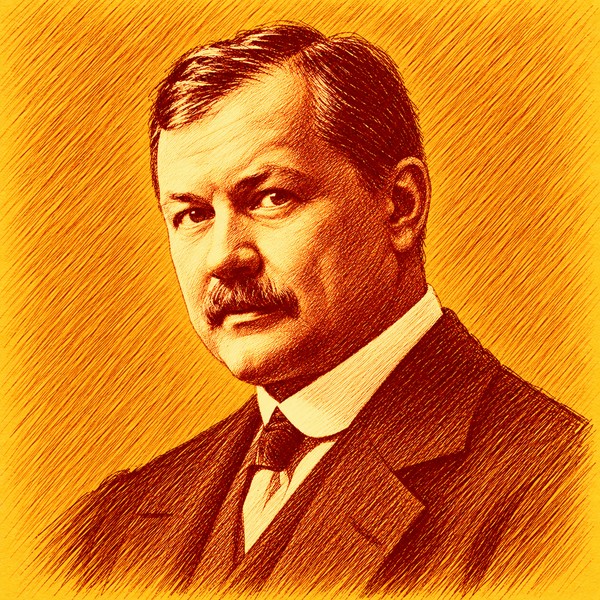
Franz Lehár (1870–1948) was born in Komárom, then part of Austria-Hungary, into a military musical family. He studied violin and composition at the Prague Conservatory and began his professional career as an orchestral violinist before following his father into service as an Austro-Hungarian military bandmaster. Eventually settling in Vienna, he turned increasingly to composition and the theater. His international breakthrough came in 1905 with an operetta whose extraordinary popularity made him the leading figure of the so-called Silver Age of Viennese operetta.
Lehár’s theatrical music combines Viennese dance rhythms and memorable popular melody with increasingly rich orchestration and an operatic breadth of expression. His masterpiece, Die lustige Witwe (The Merry Widow), became one of the most successful operettas ever written. Other important stage works include Der Graf von Luxemburg, Paganini, Der Zarewitsch, Friederike, and Das Land des Lächelns, the last containing the famous tenor song Dein ist mein ganzes Herz. His later works, many associated with Richard Tauber, moved operetta toward a more romantic and emotionally expansive style.

###
Lehár, Ferencz [Franz Lehár] (b Komáron, 1870; d Bad Ischl, 1948). Austro-Hung. composer. Advised by Dvořák to concentrate on comp. Joined Elberfeld opera orch. as violinist, then became ass. leader of his father's band. Cond. of various army bands 1890-1902. Cond., Theater an der Wien, Vienna, 1902. His Wiener Frauen was produced there Nov. 1902 and after its success he stayed in Vienna and devoted his time to comp. His operetta, Die lustige Witwe (The Merry Widow) was a colossal success not only at its Vienna première in 1905 but all over the world ever since. He was the bridge between the Strausses and Zeller and the later Oskar Straus, Fall, and Kálmán. In the 1920s the v. of Richard Tauber became indelibly associated with Lehár roles and one above all—in Das Land des Lächelns (The Land of Smiles)—a rev. of Die gelbe Jacke (1923)—in 1929. He wrote a full-scale opera, Giuditta (Vienna State Opera, 1934) and several other operettas: Der Graf von Luxemburg (The Count of Luxemburg) (1909), Zigeunerliebe (1910), Frasquita (1922), Paganini (1925), Der Zarewitsch (1926), and Friederike (1928). Also wrote sonatas, sym.-poems, vn. conc., marches, and dances (incl. the concert-waltz Gold and Silver, 1902). His villa in Bad Ischl is now a museum and an annual Lehár Fest. is held in the spa. Cond. Vienna PO in prog. of his mus., Salzburg Fest. 1940.
Copyright © 1996 Oxford University Press - By permission of Oxford University Press
###
Read biography at allmusic.com.
|
|
Franz Lehár (1870–1948) was born in Komárom, then part of Austria-Hungary, into a military musical family. He studied violin and... More
|
 Files of this type are not available at this time. Please select ALL from above.
-
Stage Works
1 midi
-
Stage Works
1 midi