Composer (MIDI)
Mikhail Ivanovich Glinka (1804-1857); RUS
 Loading, please wait...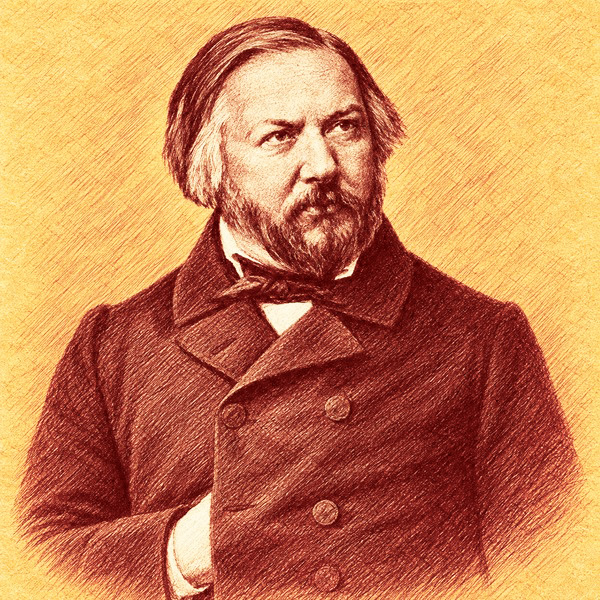
Mikhail Ivanovich Glinka (1804–1857) was born near Smolensk into a prosperous Russian family and is widely regarded as the foundational figure of Russian classical composition. He received a cosmopolitan education and traveled extensively in Italy and Germany, where encounters with European opera and composition sharpened his desire to create a distinctly Russian musical language. Returning to Russia, he achieved a landmark success in 1836 with his first opera. Glinka later traveled again through western Europe and spent significant periods abroad, including in Spain, whose music inspired several orchestral works. He died in Berlin in 1857.
Glinka’s opera A Life for the Tsar established a model for Russian historical opera, while Ruslan and Lyudmila opened another path through its exotic color, modal harmony, and treatment of Russian literary and legendary subjects. His orchestral fantasy Kamarinskaya, built from Russian folk melodies, became especially influential on later nationalist composers; Tchaikovsky famously recognized in it the germ of the Russian symphonic school. The Spanish overtures Jota Aragonesa and Summer Night in Madrid display his brilliant orchestration, while songs and chamber works reveal his lyrical gifts. Glinka’s example profoundly influenced Balakirev, Mussorgsky, Rimsky-Korsakov, Borodin, and later generations seeking a recognizably Russian art music.

###
Read biography at allmusic.com.
|
|
Mikhail Ivanovich Glinka (1804–1857) was born near Smolensk into a prosperous Russian family and is widely regarded as the foundational... More
|
 Files of this type are not available at this time. Please select ALL from above.
 Click on a category to view the list of works
-
Stage Works
1 midi
-
Vocal Works
2 midis
- Solo Songs and Song Cycles
2 midis
- Doubt, G.x108
1 midi
- Izhe kheruvimyi
1 midi
- Doubt, G.x108
- Solo Songs and Song Cycles
-
Piano Works
1 midi
- 3 Fugues
1 midi
- 3 Fugues
-
Stage Works
1 midi
-
Vocal Works
2 midis
- Solo Songs and Song Cycles
2 midis
- Doubt, G.x108
1 midi
- Izhe kheruvimyi
1 midi
- Doubt, G.x108
- Solo Songs and Song Cycles
-
Piano Works
1 midi
- 3 Fugues
1 midi
- 3 Fugues